About Sula leucogaster (Boddaert, 1783)
Plumage (Adult)
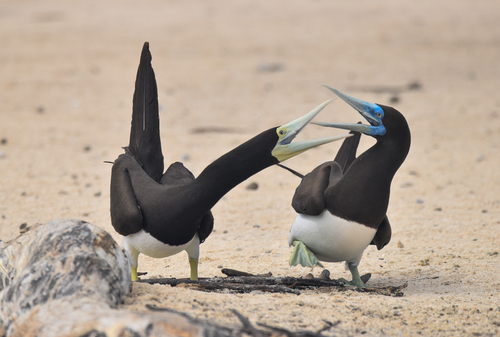
This species, the brown booby (Sula leucogaster), has dark brown to blackish plumage covering its head and upper back, with contrasting white plumage on its belly.
Bare Part Coloration
The color of its bare body parts varies between geographic regions, but does not change with seasons. The species shows sexual dimorphism in bare part coloration: males have a blue orbital ring, while females have a yellow orbital ring.
Female Size
Females grow to around 80 centimetres (31 in) in length, with wingspans reaching up to 150 cm (4.9 ft), and can weigh up to 1,300 g (2.9 lb).
Male Size
Males grow to around 75 centimetres (30 in) in length, with wingspans reaching up to 140 cm (4.6 ft), and can weigh up to 1,000 g (2.2 lb).
Juvenile Plumage
Unlike other sulid species, juvenile brown boobies already have plumage that resembles adult plumage. Juveniles are grey-brown with darker coloration on the head, upper wing surfaces, and tail, while the lower breast and underpart plumage has heavy brown flecking over a white base.
Beak Structure
Their beaks are quite sharp and have jagged edges.
Wing and Tail Structure
They have fairly short wings that produce a fast flap rate, paired with long, tapered tails.
Vocalizations
These birds are typically silent, but will occasionally make grunting or quacking sounds.
Breeding Distribution
This species breeds on islands and coasts in pantropical regions of the Atlantic, Indian, and Pacific oceans, and commonly uses breeding grounds on islands in the Gulf of Mexico and the Caribbean Sea.
Nest Debris Use
As global marine pollution has increased, brown boobies have started using marine debris to build their nests: 90.1% of these nests are made up of plastic, and nests near shipwrecks contain a high percentage of wreckage debris.
Colony Nesting
This bird nests in large colonies, laying two chalky blue eggs on the ground in a mound of broken shells and vegetation, but usually only raises one chick.
Sibling Competition
The second chick to hatch cannot compete for food with its older sibling, and is even sometimes ejected from the nest by the older sibling.
Winter Range
It winters at sea across a wider range than its breeding range.
Pair Bonding
Pairs of brown boobies may stay together across multiple breeding seasons.
Courtship and Diving Behavior
The pairs perform elaborate greeting rituals, and the species is also known for being spectacular divers that plunge into the ocean at high speed.
Diet
They mainly eat small fish including flying fish, mullets, halfbeaks, anchovies, goatfish, crowned squirrelfish, and Indian mackerels, squids including species from the family Ommastrephidae, and shrimps that gather in groups near the ocean surface.
Surface Feeding
They may also catch leaping fish while skimming the water surface.
Kleptoparasitism
In addition to plunge-diving, some fledglings and adult brown boobies practice kleptoparasitism, stealing prey from other seabirds. They have even been observed stealing prey from great frigatebirds, a species normally considered more prone to piracy, as great frigatebirds transfer food to their young.
Flight and Takeoff
Although brown boobies are powerful and agile fliers, they are particularly clumsy during takeoffs and landings, and rely on strong winds and high perches to help them take off.