About Minla strigula (Hodgson, 1837)
Nomenclature
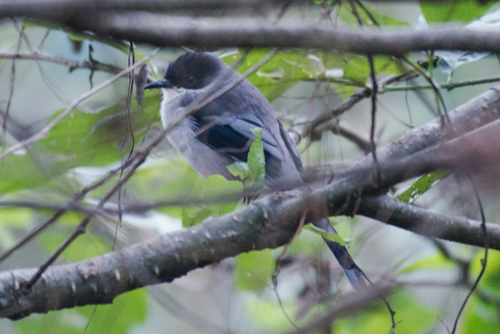
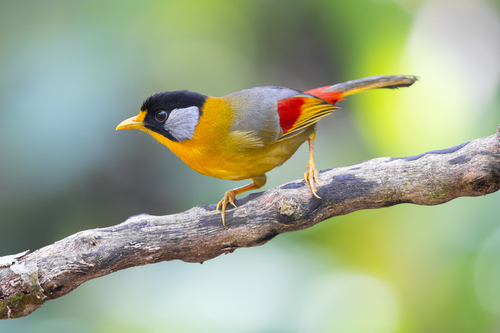
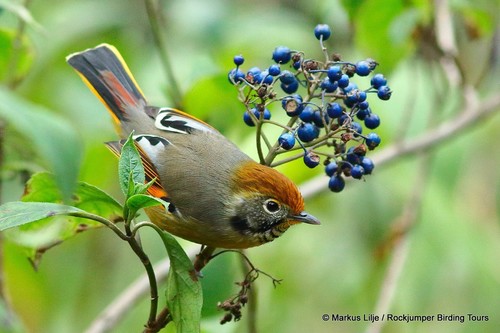
The bar-throated minla, also called the chestnut-tailed minla or bar-throated siva, is a bird species in the laughingthrush and babbler family Leiothrichidae. Its scientific name is currently Actinodura strigula; it was traditionally placed in the genus Minla, and is still referenced as Minla strigula under that older classification.
Distribution Range
This species occurs in montane forests stretching from India to Malaysia.
Subspecies
Eight subspecies have been described, and six of these are widely accepted. The accepted subspecies and their distributions are as follows: the nominate subspecies is found from central Nepal through India, southern China and Bhutan; C. s. simlaensis occurs in northern India and western Nepal; C. s. yunnanensis occurs in north-eastern India, southern China, northern Burma, Laos and Vietnam; C. s. castanicauda occurs in southern Burma and western and northern Thailand; C. s. malayana occurs in Peninsular Malaysia; C. s. traii is restricted to central Vietnam.
Habitat
The bar-throated minla lives in a range of montane forest habitats at elevations between 1,800 m and 3,750 m (5,910–12,300 ft).
Altitudinal Movement
The species is mostly non-migratory, but may move to lower altitudes during harsh winters, reaching as low as 1,300 m (4,300 ft).
Forest Types
Forest types it can be found in include evergreen broadleaf forest, mixed broadleaf and evergreen forest, pine forest, pine or oak and rhododendron forest, rhododendron stands, and bamboo stands.
Seasonal Diet Variation
The diet of the bar-throated minla changes with the seasons. In summer, it feeds almost entirely on insects, including beetles, caterpillars, and other insect types.
Non-summer Food Items
In winter, it also consumes berries, seeds, and nectar.
Non-breeding Behaviour
During the non-breeding season, it joins mixed flocks with other babblers and yuhinas, and feeds from the forest canopy down to near the forest floor.
Breeding
It lays between two and four eggs in a cup-shaped nest built from grass, bamboo leaves, lichen, and birch bark.