About Leiothrix argentauris (Hodgson, 1837)
Species Classification and Nomenclature
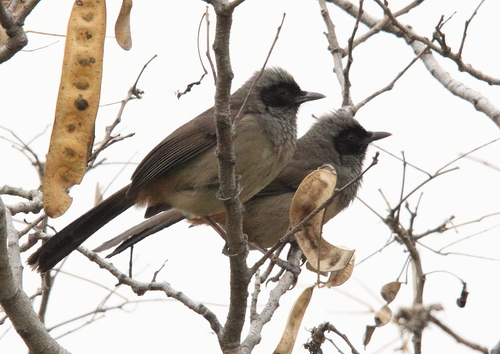
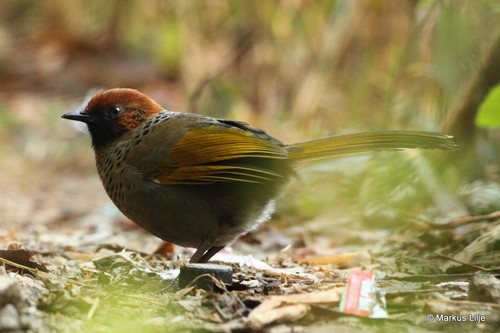
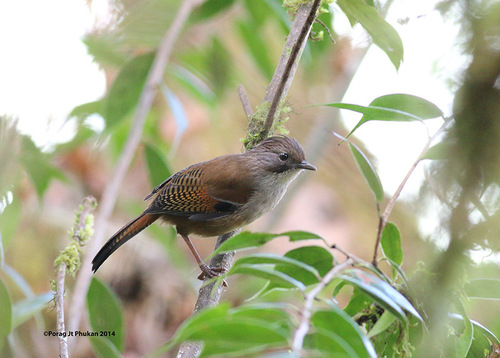
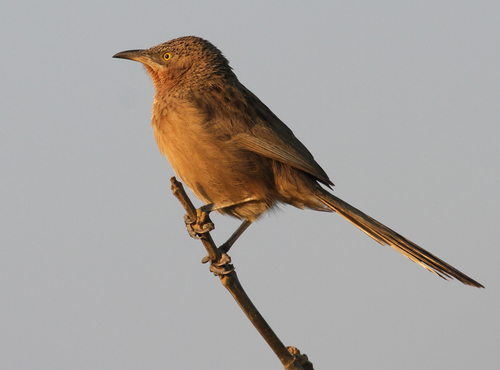
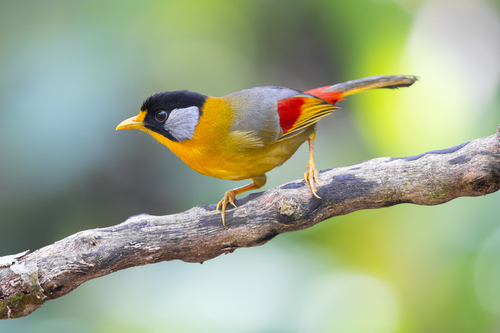
The silver-eared mesia, with the scientific name Leiothrix argentauris (Hodgson, 1837), is a species of bird native to Southeast Asia. This species was previously classified in the large Old World babbler family Timaliidae.
Family Placement
After recent taxonomic splits of this family, it is now placed with laughingthrushes in the new family Leiothrichidae. Some taxonomic treatments place this species in its own genus Mesia, while others place it in the genus Leiothrix alongside the red-billed leiothrix.
Subspecies Plumage Variation
There are seven described subspecies, which show considerable plumage variation between them. Further research is required to confirm whether all these subspecies represent a single species.
Subspecies Distribution List
The seven subspecies and their distributions are as follows: L. argentauris argentauris (Hodgson, 1837) occurs in northern and eastern India, Bhutan, northern Burma and southern China.
Subspecies L. a. galbana Distribution
L. argentauris galbana (Mayr & Greenway, 1938) occurs in southern Burma and northern Thailand.
Subspecies L. a. ricketti Distribution
L. argentauris ricketti (La Touche, 1923) occurs in Yunnan, Guizhou and Guangxi in China, as well as northern Laos and Vietnam.
Subspecies L. a. cunhaci Distribution
L. argentauris cunhaci (Robinson & Kloss, 1919) occurs in southern Laos and Vietnam, and Cambodia.
Subspecies L. a. tahanensis Distribution
L. argentauris tahanensis (Yen Kwokyung, 1934) occurs in southern Thailand and Peninsular Malaysia.
Subspecies L. a. rookmakeri Distribution
L. argentauris rookmakeri (Junge, 1948) occurs in northern Sumatra.
Subspecies L. a. laurinae Distribution
L. argentauris laurinae (Salvadori, 1879) occurs in southern Sumatra.
Migratory Behavior
This species is generally resident, but it has been recorded as a winter visitor to Nameri National Park in Assam, India, which suggests it may be an altitudinal migrant.
Introduced Population
A population of this species has been introduced to Hong Kong, originating from escaped captive caged birds.