About Platycercus venustus (Kuhl, 1820)
Common Name & Size Comparison
Platycercus venustus, commonly known as the northern rosella, is smaller than all other rosella species except the western rosella.
Adult Morphometrics
Adult northern rosellas weigh 90 to 110 g (3.2 to 3.9 oz), measure 29 to 32 cm (11 to 13 in) long, have broad wings with a wingspan of around 44 cm (17 in), and a long twelve-feathered tail.
Sexual Dimorphism
The sexes are almost indistinguishable, though some adult females have duller plumage and are more likely to have red feathers on the head and breast.
Adult Head Plumage
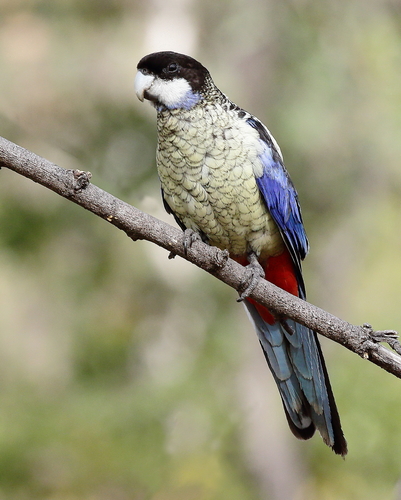
Adult birds have black feathers on the forehead, crown, lores, ear coverts, upper neck and nape, along with a whitish throat and large cheek patches.
Subspecific Cheek Patch Variation
In the nominate subspecies, these cheek patches are mainly white with violet lower borders; in subspecies hillii, they are mostly blue with a narrow white upper segment.
Upper Neck & Torso Plumage
Feathers on the lower neck, mantle and scapulars are black with narrow yellow fringes, creating a scalloped appearance.
Body Plumage Pattern
Feathers on the back, rump, upper tail coverts and underparts are pale yellow with black borders and concealed grey bases; breast feathers have very dark grey bases, and are occasionally tinged with red.
Undertail Covert Plumage
Undertail covert feathers are red with black fringes.
Upper Leg Plumage
Feathers on the upper leg are pale yellow tinged with blue.
Uppertail Plumage
The central rectrices of the long tail are dark green, turning dark blue at the tips, while the other tail feathers are dark blue with two pale blue bands and white tips.
Undertail Plumage
The undertail is pale blue with a white tip.
Wing Plumage
When at rest, the wings show a wide purplish blue shoulder patch; secondary feathers are edged with darker blue, and primary feathers are black edged with blue.
Soft Part Coloration
The beak is off-white with a grey cere, the legs and feet are grey, and the iris is dark brown.
Immature Plumage
Immature birds resemble adults but are duller overall, with less well-defined cheek patches. Their black plumage in particular is more greyish, and they are more likely to have scattered red feathers on the head, neck and underparts.
Species Range Overview
The northern rosella is found across northern Australia.
Western Australia Distribution
In Western Australia, it occurs across the Kimberley region south to the 18th parallel, around Derby, Windjana Gorge National Park, the northern Wunaamin Miliwundi Ranges, Springvale Station and Warmun; vagrants have been recorded at Halls Creek and Fitzroy Crossing.
Northern Territory Distribution
In the Northern Territory, it ranges from the Victoria River north to the Tiwi Islands, east into western Arnhem Land, and across northern Arnhem Land through Milingimbi Island and the Wessel Islands to the Gove Peninsula.
Eastern Range Distribution
It is absent from central Arnhem Land, but occurs further east around the western and southern coastline of the Gulf of Carpentaria, south to Borroloola, and across the border into western Queensland as far as the Nicholson River.
General Habitat Type
Northern rosellas live in grassy open forests and woodlands, including deciduous eucalypt savanna woodlands.
Habitat Tree Species
Common tree species found in their habitat include Eucalyptus such as Darwin stringybark (Eucalyptus tetrodonta), Melaleuca, Callitris and Acacia.
Specific Habitat Locations
More specific habitats include vegetation along small creeks and gorges, sandstone outcrops and escarpments, and some forested offshore islands.
Uncommon & Avoided Habitats
The northern rosella is occasionally found in mangroves or public green spaces in suburban Darwin, and it avoids dense forest.