About Melanerpes pulcher P.L.Sclater, 1870
Species Naming and Length
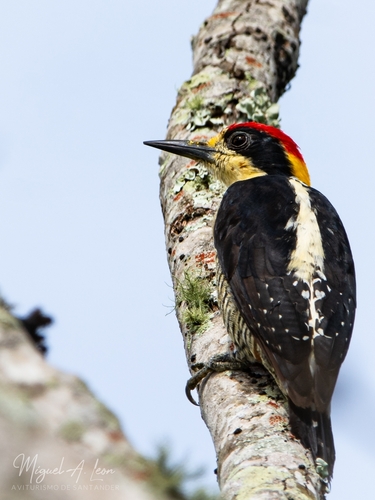
Description: The beautiful woodpecker (Melanerpes pulcher) measures about 17 to 18 cm (6.7 to 7.1 in) in length. Males and females look similar except for the pattern on their head.
Adult Male Head Pattern
Adult males have a whitish forehead, a scarlet crown, and golden yellow on the lower nape and hindneck.
Adult Female Head Pattern
Adult females share the same whitish forehead and yellow hindneck, but have a black forecrown and scarlet hindcrown and nape.
Facial and Neck Markings
Both sexes have black coloring around the eye that extends down the side of the neck. Their lores, cheeks, chin, throat, and breast range from white to cream or pale yellow.
Upperparts Plumage
Their mantle and upper wings are mainly black, with some white barring on the flight feathers, while the back and rump are white, sometimes marked with black blotches.
Lower Body and Tail Plumage
Their tail is brownish black; the lower breast, belly, and flanks have black and white barring, and there is a red patch on the mid-belly.
Soft Part Coloration
Their iris is very dark brown, the beak is blackish with a paler base, and their legs are gray.
Juvenile Plumage Characteristics
Juveniles are duller than adults, their black areas are browner, the barring on their underparts is less contrasting, and their belly patch is smaller and more orange.
Geographic Range
Distribution and habitat: The beautiful woodpecker is endemic to the Magdalena River valley in north central Colombia.
Primary Habitat Types
It primarily lives in mature open forests of both dry and humid types. It is sometimes found in plantations, and occasionally occurs in fragmented and secondary forest.
Elevation Range
It inhabits elevations ranging between 400 and 1,500 m (1,300 and 4,900 ft).