About Yungipicus maculatus (Scopoli, 1786)
Common Name and Initial Habitat
Yungipicus maculatus (Scopoli, 1786), commonly called the Philippine pygmy woodpecker, is a small woodpecker described by eBird as inhabiting foothill and low-elevation montane forest, as well as more open wooded areas.
Underpart and Facial Markings
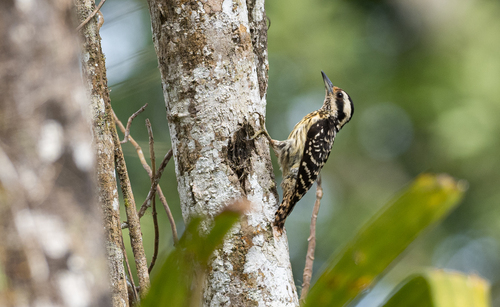
This species has white speckled underparts that extend to a dotted moustache stripe on its face.
Upperpart and Head Markings
Its dark brown upperparts are marked with white barring on the back and white bands on the head.
Male Secondary Sex Character
Males have a red mark on the back of the head.
Distinguishing Feature
eBird notes the species is unmistakable, as no other woodpecker of a similar size occurs within its range.
Vocalization
Its voice consists of a short, slightly metallic rattling trill.
Past Taxonomic Treatment
In past taxonomic treatments, this taxon included the Sulu pygmy woodpecker, which is now recognized as a separate distinct species.
Superspecies Placement
Yungipicus maculatus, the Sulu pygmy woodpecker, and the Sulawesi pygmy woodpecker appear to form a superspecies.
Genus Classification Dispute
Some taxonomic authorities still place this species in the genus Dendrocopos or Picoides.
Habitat and Elevation Range
This woodpecker lives in primary or secondary forests, plantations, forest edge, and even clearings with scattered trees, and can be found at altitudes up to 2,500 meters above sea level.
IUCN Red List Status
The IUCN Red List has assessed this species as least concern, as it is common across its entire range, which covers the whole Philippines.
Population Trend and Habitat Tolerance
Its population is currently recorded as stable, and the species appears to be tolerant of degraded habitat.
Diet
Philippine pygmy woodpeckers feed mostly on insects.
Social Structure
They can be found singly, in pairs, in small groups of up to 5 individuals, and sometimes join mixed-species flocks that include the Elegant tit, Sulphur-billed nuthatch, white-eyes, and other small birds.
Foraging Behavior
They forage high in trees on twigs and smaller branches, and favor dead trees, where they typically peck and hammer before searching for food in bark and foliage.
Breeding Period and Nesting
The species' breeding season runs from February to August, and it nests in tree holes during this period.