About Dendropicos goertae (P.L.S.Müller, 1776)
Morphological Adaptations
Like other woodpeckers, this species has a straight, pointed bill, a stiff tail that provides support against tree trunks, and zygodactyl or "yoked" feet, with two toes pointing forward and two pointing backward. Its long tongue can be darted forward to capture insects.
Body Size
This bird is 20 cm (7.9 in) in length.
Plumage General
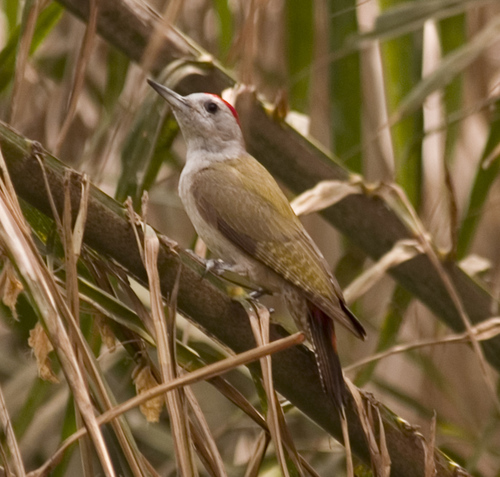
It has the typical shape of a woodpecker, with unmarked green upperparts and a pale grey head and underparts.
Distinct Plumage Markings
The rump is red, and there is a small red patch on the belly. The short tail is blackish.
Adult Male Plumage
Adult males of this grey woodpecker have a red crown.
Adult Female Plumage
Females have a plain grey head and do not have a red crown.
Juvenile Plumage
Young birds resemble females, but their red markings are paler, and they may have some barring on their flanks.
Species Distribution Range
The African grey woodpecker is native to tropical regions of western and central Africa. Its range covers Angola, Benin, Burkina Faso, Burundi, Cameroon, Central African Republic, Chad, Congo, Democratic Republic of Congo, Equatorial Guinea, Eritrea, Ethiopia, Gabon, Gambia, Ghana, Guinea, Guinea-Bissau, Ivory Coast, Kenya, Liberia, Mali, Mauritania, Niger, Nigeria, Rwanda, Senegal, Sierra Leone, South Sudan, Sudan, Tanzania, Togo and Uganda.
Habitat Types
Its typical habitats include woodland, savannah with isolated trees, copses of larger trees, riverside forest and pasture.
Diet
Like other woodpeckers, this species is an insectivore.
Drumming Behavior
It is seen frequently, and regularly taps or drums on wood.
Vocalization
Its call is a loud, fast series of peet-peet-peet-peet.