About Melanerpes pucherani (Malherbe, 1849)
Common Name and Size
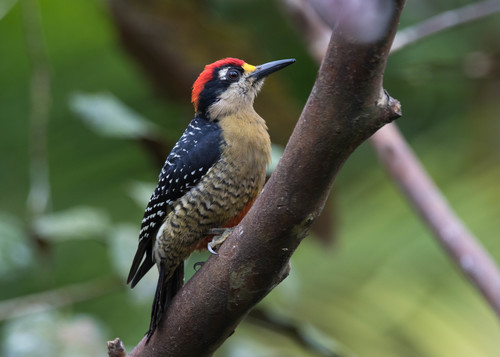
Melanerpes pucherani, commonly called the black-cheeked woodpecker, measures 17 to 19 cm (6.7 to 7.5 in) long and weighs 42 to 68 g (1.5 to 2.4 oz). The plumage of males and females is identical except for their head pattern.
Adult Male Head Pattern
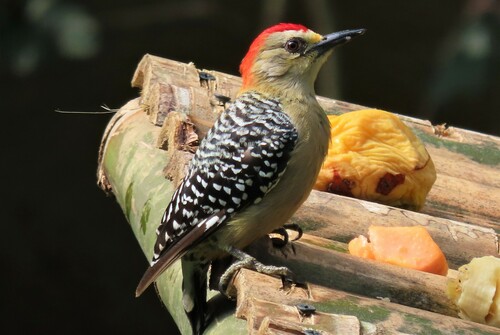
Adult males have a golden yellow forehead, and a red crown and nape.
Adult Female Head Pattern
Adult females have a white to buffy white forehead, a black central crown, and a red hindcrown and nape.
Shared Adult Head Markings
Both sexes have black plumage around the eye that extends down the side of the neck, plus a white line behind the eye.
Back and Uppertail Coverts Plumage
Their upper back has black and white bars; their lower back and uppertail coverts are white with a pale buff tinge, and sometimes have a few blackish bars.
Flight Feathers Plumage
Their flight feathers are black or brownish black with narrow white tips and white bars across the entire feather.
Tail Plumage
Their tail is black, with white bars on the central pair of feathers.
Facial and Upper Throat Plumage
Their lores, cheeks, chin, and upper throat are whitish.
Underparts Plumage
Their lower throat and breast are olive-buff with a gray tinge; the rest of their underparts are buffish white with strong wavy bars, and have a red spot in the center of the belly. Their undertail coverts are yellow-brown.
Bare Part Morphology
Their bill is moderately long and black, with a paler base to its lower mandible; their iris is brown, the bare skin around the eye is brown to grayish, and their legs are greenish gray to olive.
General Juvenile Plumage Characteristics
Juveniles are duller and browner than adults, with more diffuse barring and a smaller, paler red belly spot.
Juvenile Sexual Dimorphism
Juvenile males have an orangey red nape, and juvenile females have much less red on their crown than adult females.
Northern Distribution Range
This species is found from Veracruz and Chiapas in southern Mexico, south along the Caribbean slope into Costa Rica.
Southern Distribution Range
From Costa Rica it occurs on both slopes in Panama, continuing through western Colombia and western Ecuador to just reach the northern edge of Peru.
Habitat Types
The black-cheeked woodpecker lives in the interior and edges of humid to wet evergreen forest, mature secondary forest, and abandoned plantations, as well as clearings with scattered trees. It is sometimes found in gardens, even gardens located far from forest.
Elevation Range
Most individuals occur between 700 and 900 m (2,300 and 3,000 ft) in elevation, but it can occasionally be found up to 1,200 m (3,900 ft), and in Ecuador it occurs locally as high as 1,500 m (4,900 ft).