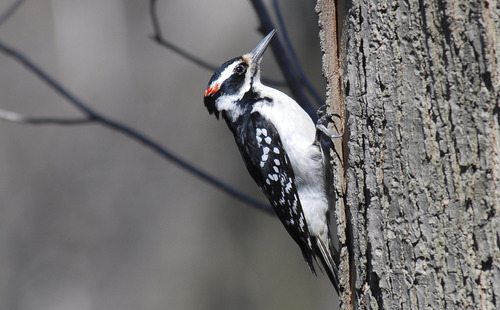
About Campethera punctuligera (Wagler, 1827)
Common and scientific name
This species, commonly called the fine-spotted woodpecker, has a scientific name of Campethera punctuligera (Wagler, 1827).
Body size and shape
This bird reaches 22 cm (8.7 in) in length, and has the typical woodpecker body shape.
Upperpart coloration
Its upperparts are green, marked with small pale spots; the rump and tail instead have pale bars.
Underpart coloration
Its underparts are whitish or yellowish, with fine dark spots covering the breast, belly, and flanks.
Head coloration
The head is whitish with greyer cheeks and chin, which also have tiny dark spots.
Adult male plumage
Adult males have a red crown and red moustachial stripes.
Adult female plumage
Females have a dark forecrown, with red only on the rear half of the crown, and do not have red moustaches.
Juvenile plumage
Young birds resemble females, but their green plumage is darker.
Morphological adaptations
Like other woodpeckers, this species has a straight pointed bill, a stiff tail that provides support against tree trunks, and zygodactyl (or "yoked") feet with two toes pointing forward and two pointing backward.
Feeding adaptation
Its long tongue can be darted forward to capture insects.
Vocalization
This is a vocal species, and its call is a loud kip-kip-kip-kiech-kiech-kiech.
Native range
The fine-spotted woodpecker is native to the Sudan region and adjacent areas.
Habitat
Its typical habitat includes wooded savannah, scrub, and grassland with scattered Acacia and other trees.
Diet
Like other woodpeckers, this species is insectivorous.
Feeding behavior
It is a specialist feeder on termites, is frequently seen near termite mounds, and picks insects off of trees and the ground.
Foraging behavior
It often forages in small family groups, and may join mixed-species bird flocks.
Nesting and clutch
Its nest is built in a tree hole, often in an oil palm, and its clutch contains two or three white eggs.