About Dryobates minor (Linnaeus, 1758)
Taxonomic Identity
Dryobates minor, the lesser spotted woodpecker, is the smallest woodpecker species native to Europe.
Adult Size Range
Adult individuals measure 14 to 16.5 cm (5.5 to 6.5 in) in length, have a wingspan of 24 to 29 cm (9.4 to 11.4 in), and weigh 17 to 25 g (0.60 to 0.88 oz).
Great Britain Mass Sample
A sample of 50 lesser spotted woodpeckers in Great Britain had an average body mass of 19.8 g (0.70 oz).
Detection Difficulty
Due to its small size and its habit of spending most of its time in the crowns of tall trees in woodlands and parks, this small woodpecker is often overlooked.
Field Identification Markers
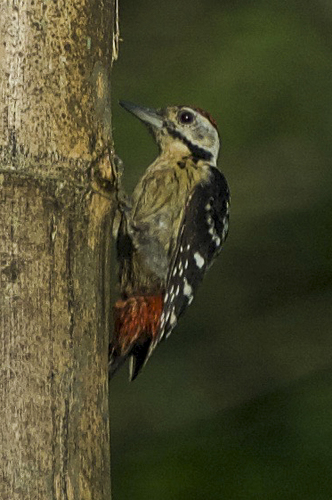
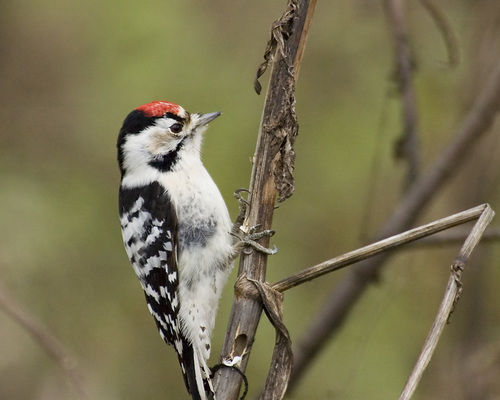
If seen on a tree trunk, it can be immediately identified by broad barring on the wings and narrower bars across the lower back.
Male Plumage Features
Males have a crimson crown, a brown forehead, a black superciliary stripe, and an additional black stripe running from the base of the bill to the neck.
Male Dorsal Plumage
The nape and upper back are black, while the lower back has alternating black and white bars.
Male Wing and Tail Plumage
The wings have broader, more prominent bars, and the outer tail feathers are also barred.
Male Underpart Plumage
The underparts are white with streaks on the flanks.
Male Bare Part Coloration
The bill and legs are slate-grey.
Female and Juvenile Plumage
Females have a white crown, while young birds of both sexes have more or less crimson coloring on the head.
Seasonal Plumage Variation
There are no distinct seasonal plumage changes.
Behavioral Similarities to Great Spotted Woodpecker
The habits of Dryobates minor are very similar to those of the great spotted woodpecker, and it shares the same stumpy, almost triangular outline when moving between trees.
Vocalization Characteristics
Its call is a repeated "keek", which is loud for a bird of its size, and its vibrating rattle call can be distinguished from that of the larger great spotted woodpecker with experience.
Rattle Call Usage
This rattle, which serves as its song, can be heard at any time of year, but is most frequent when courtship begins early in the year.
Diet Composition
Its insect-based diet is similar to that of the great spotted woodpecker.
Foraging Signs
When searching for wood-boring larvae, it chips away at rotten wood, and accumulations of wood chippings at the base of a tree are often the first sign that the bird has been foraging for insects in the upper branches.
Non-breeding Diet
From autumn through spring, it hunts mainly for wood-dwelling insect larvae, most often on thin dead branches attached to living trees.
Breeding Season Diet
During the breeding season, surface-living insects collected from tree foliage and bark make up an increased proportion of its diet.
Nestling Diet
Nestlings are mainly fed surface-living insects such as aphids and insect larvae.
Roosting Behavior
At night, the species roosts in old tree holes.
Nesting Hole Identification Clues
Accumulations of wood chips are also a clue to the location of a nesting hole, because the bird does not always carry excavated chippings away.
Nesting Hole Height
The nesting hole is usually located a considerable height above the ground, and can be as high as 10–20 m (33–66 ft).
Nesting Hole Entrance Size
The hole is smaller than that excavated by the great spotted woodpecker, with an entrance diameter of 2.5–5 cm (0.98–1.97 in).
Nesting Cavity Dimensions
The vertical tunnel length varies, and the nesting cavity is often 30 cm (12 in) or more below the entrance.
Egg Laying and Brood Frequency
Five to eight highly polished white eggs are laid on a bed of wood dust and chippings in the latter half of May, and the species typically raises only a single brood per year.
Incubation Behavior
Both parents help incubate the eggs.
Alternative Nesting Sites
Occasionally, old or naturally occurring tree hollows are used or enlarged for nesting.
Movement Patterns
Most populations of lesser spotted woodpeckers are resident, though they can be somewhat nomadic.
Population Fluctuations
Annual fluctuations in population size are common.
Environmental Drivers of Survival and Breeding
Winter temperatures may directly affect the winter survival of lesser spotted woodpeckers through increased heat loss, while spring weather conditions indirectly affect breeding success by impacting food availability.
UK Population Decline
In 2017, it was reported that the UK population of lesser spotted woodpeckers had almost halved since 2009, falling to around 2,000 individuals.
Decline Cause
The British Ornithology Trust attributed this decline to the modern practice of quickly removing dead trees from parks and woodlands, which deprives the birds of the decaying wood that is their preferred nesting habitat.