About Macaca arctoides (I.Geoffroy Saint-Hilaire, 1831)
Scientific Name
The stump-tailed macaque, with the scientific name Macaca arctoides (I.Geoffroy Saint-Hilaire, 1831), has the following characteristics.
Adult Fur & Tail
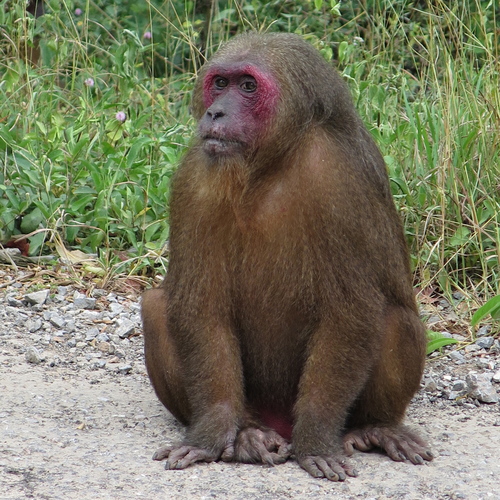
It has long, thick, dark brown fur, a hairless face, and a short tail that measures between 32 and 69 mm (1.3 and 2.7 in).
Cheek Pouches
It has cheek pouches that it uses to store food for short periods of time.
Infant Coloration
Infants are born white and darken in fur color as they mature.
Facial Aging Changes
As the macaques age, their bright pink or red faces darken to brown or nearly black and lose most of their hair.
Sexual Size Dimorphism
Males are larger than females: males measure 51.7–65 cm (20.4–25.6 in) long and weigh 9.7–10.2 kg (21–22 lb), while females measure 48.5–58.5 cm (19.1–23.0 in) long and weigh 7.5–9.1 kg (17–20 lb).
Canine Teeth Dimorphism
Male canine teeth, which are important for establishing dominance within social groups, are more elongated than female canine teeth.
Geographic Range
For distribution and habitat, the stump-tailed macaque ranges from northeastern India, Myanmar, Thailand, and the northwest tip of Peninsular Malaysia to Laos, Cambodia, Vietnam, and southern China.
Native Habitat
It lives in evergreen, tropical, and subtropical moist broadleaf forests at elevations up to 4,000 m (13,000 ft).
Habitat Requirements
It relies on rainforests for food and shelter, and only enters secondary forests if those forests border old-growth tropical forests.
Bangladesh Population Status
The species is possibly extinct in Bangladesh.
Cambodia Population
In Cambodia, a population of 230 individuals has been reported in Keo Seima Wildlife Sanctuary.
Introduced Mexican Population
A study population was introduced to Tanaxpillo, an uninhabited island in Lake Catemaco, Veracruz, Mexico in 1974, where the population lives under seminatural conditions.
Study Population Basis
Most scientific information about this species comes from the introduced population on Tanaxpillo and other captive settings, because few long-term studies have been conducted on wild stump-tailed macaques.
General Social Structure
For behaviour and ecology, stump-tailed macaques generally share the typical social structure of other macaque species.
Dominance Hierarchy
They have a linear dominance hierarchy that is hereditary among females, but fluctuates among males based on fighting ability and social maneuvering.
Conflict Behavior
Compared to rhesus macaques and long-tailed macaques, stump-tailed macaques defuse intense confrontations, are relatively tolerant of their group members, and have a surprisingly large repertoire of reconciliation tactics.
Female Reproductive Hormones
For reproduction, research on a study population found that female stump-tailed macaques have increased levels of steroid sex hormones, specifically 17β-estradiol and progesterone.
Hormone Seasonal Patterns
17β-estradiol levels are significantly higher during summer and fall, while progesterone levels are significantly higher during summer, fall, and winter.
Mating Seasons
This pattern explains why stump-tailed macaques have two mating seasons each year: one in summer (July–August) and one in fall (November).
Birth Frequency Support
This finding is supported by the distribution of birth frequency in the species.