About Macaca radiata (É.Geoffroy Saint-Hilaire, 1812)
Common Name and Sexual Dimorphism
This species, commonly called the bonnet macaque, has distinct physical size differences between males and females.
Head-Body and Tail Length
Males have a head-body length of 51.5–60 cm (20.3–23.6 in) with a 51–69 cm (20–27 in) tail, while females have a head-body length of 34.5–52.5 cm (13.6–20.7 in) with a 48–63.5 cm (18.9–25.0 in) tail.
Body Weight
Males weigh 5.4–11.6 kg (12–26 lb), and females weigh 2.9–5.5 kg (6.4–12.1 lb).
Head Cap Feature
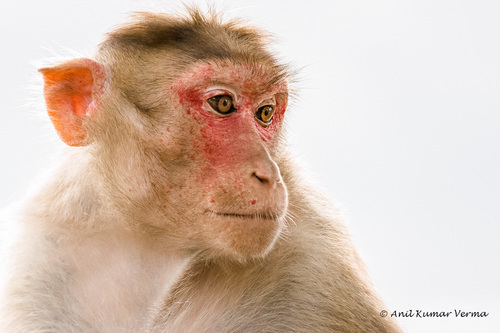
Bonnet macaques have a cap-shaped whorl on the top of their heads that spreads outward from the center.
Fur and Ear Coloration
Their body fur can be either dark brown or yellow, and they have characteristic black ears.
Female Facial Color During Reproduction
Female bonnet macaques typically have redder faces during gestation and lactation.
Habitat-Related Size Variation
Forest-dwelling bonnet macaques are generally smaller than conspecifics that live in open habitats.
Activity Pattern and Habitat Use
Bonnet macaques are a diurnal, primarily arboreal species that resides in trees.
Territoriality and Habitat Characteristics
They defend their own marked territory within their settled tree areas, which are primarily fig trees near human settlements or tall trees with enough leaves to use as a food source.
Native Distribution
They are native to and distributed across the Indian peninsula.
Population Estimate by Region
The total estimated population of bonnet macaques in their native India is approximately 170,000 individuals, with an estimated 81,000 in Karnataka, 64,000 in Andhra Pradesh, 16,000 in Tamil Nadu, and 11,000 in Kerala.
Reproductive Maturity Age
Bonnet macaques reach reproductive maturity at three to four years old.
Birthing Season
The majority of births occur between February and April, before the monsoon season arrives.
Mating System
Bonnet macaques have a polygynandrous mating system.
Gestation and Litter Size
The gestation period lasts 24 weeks, and a single infant is the typical outcome of a pregnancy.
Infant Nursing and Weaning
Young bonnet macaques nurse for six to seven months, and after this period begin receiving assisted feedings of solid food from their mother.
Troop Interaction With Infants
Other members of the troop, especially related females, show interest in new infants during the infants' first months of life.