About Lythrypnus dalli (Gilbert, 1890)
Size
Blue-banded gobies (Lythrypnus dalli) reach a maximum adult size of around 64 mm (roughly 2.5 inches), with standard adult sizes ranging from 18 to 45 mm (0.7 to 1.8 inches).
Coloration
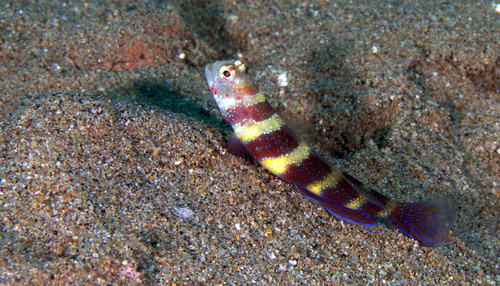
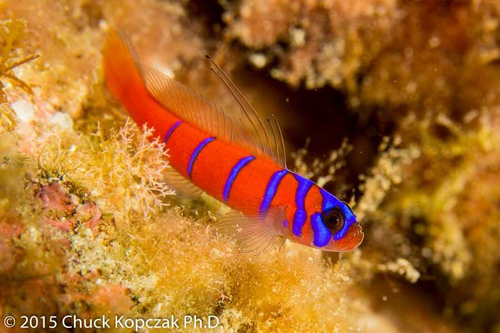
They are brightly colored coral-red, with 5 to 9 blue bands on the front portion of their bodies.
Dorsal Fin Structure
They have two dorsal fins: a tall, spiny fin positioned near the head, and a longer soft-rayed fin that extends along the back.
Pelvic Fin Function
Like the round goby, they have a wide pelvic fin on each side of their body, which they use as a suction cup to cling to rocks in fast-moving currents.
Defense Toxin
As a defense mechanism, Lythrypnus dalli secrete a mild toxin that makes them irritating to eat.
Batesian Mimicry
Other goby species mimic this species' coloration and pattern to gain this same protection.
Habitat Type
Blue-banded gobies are most commonly found in rocky reef environments, and prefer hard substrates and sloped surfaces for their habitat.
Depth Range
They are often located in open rocky areas and caves near the ocean floor, and live at depths between 0 and 76 meters (0 to 250 feet) below sea level.
Threat Response
When approached or threatened, they typically retreat into small crevices, and will sometimes take refuge among the spines of sea urchins.
Reproductive Sex Change
The blue-banded goby has a regulated reproductive system that relies on bidirectional sex change.
Social Sex Determination
Individuals can function as either female or male, depending on their social environment.
Harem Structure
Blue-banded gobies usually form harems made up of one male and multiple females.
Sex Change Trigger
If the existing male is removed by predation or is otherwise absent, the largest female in the group will switch sex to take on the male role.
Courtship Behavior
Courtship behavior involves a male rushing toward a female, nipping her genital area, and locking jaws with her.
Egg Development Pre-Deposition
Prior to deposition, developing eggs are held along the walls of the brood chamber, until an appropriate shell is found for the eggs to be deposited into.
Male Nest Guarding
Males take on the dedicated task of guarding nests, using fanning motions of their pectoral fins to support egg development while driving off intruders.
Breeding Season
Their breeding season runs from approximately February to September.
Egg Hatching Timeline
At a temperature of around 21°C, blue-banded goby eggs hatch in 4 days, and juveniles reach maturity after 3 months.
Temperature-Dependent Hatching
Blue-banded goby embryos typically hatch between 4 and 10 days, with hatching time depending on environmental temperature.
6-Somite Embryo Development
By the 6-somite stage of development, the embryo has developed a distinct head bulge and tail bud.
Pharyngula Period Development
During the pharyngula period, small patches of pigmentation can be seen on the embryo; muscle movement and a heartbeat are also present by the 9-14 prim stage.
Hatching Period Development
The hatching period follows this stage, and is marked by the start of growth for pectoral fin buds and jaws.
Flexion Period Development
Caudal fin rays begin to develop during the flexion period.
Juvenile Stage Development
After the flexion period, individuals enter the juvenile stage, where both jaws extend forward.