About Boleophthalmus pectinirostris (Linnaeus, 1758)
Coloration
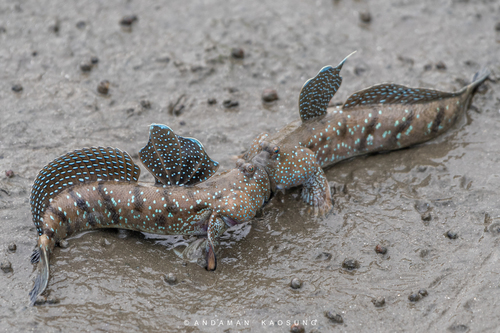
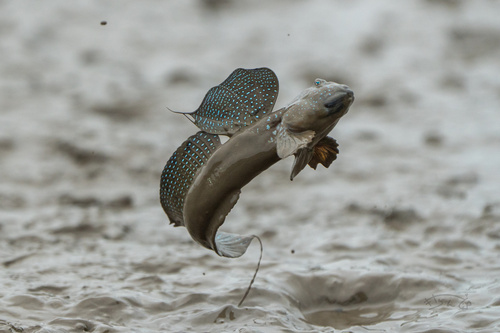
Boleophthalmus pectinirostris individuals are predominantly greenish-grey, with distinct sky blue speckles covering their entire body, including their fins and the skin beneath their eyes.
Maximum Length
They can reach a maximum length of 7 inches (18 cm).
General Distribution
This species lives in warm tropical and subtropical estuaries, and its confirmed distribution includes Peninsular Malaysia, eastern Malaysia, Sumatra (Indonesia), China, Taiwan, Korea, and Japan.
Salinity Tolerance
It is a euryhaline species that can tolerate a wide range of salinity levels.
Preferred Habitat
It favors muddy habitats near river mouths and mangroves, which provide suitable substrate for burrowing.
Sympatry Record
Its presence in Malaysia and Sumatra was only confirmed in 2009; in this region, it lives in sympatry with Boleophthalmus boddarti.
Previous Taxonomic Misidentification
Before 2009, populations of this species in the area were incorrectly identified as Boleophthalmus dussumieri, another congener related to both B. boddarti and B. pectinirostris.
Culinary Significance in Japan
Boleophthalmus pectinirostris has culinary significance in Japan, where it is fished in areas with particularly large populations.
Japanese Fishing Grounds
The main fishing grounds are the Ariake Sea and Yatsushiro Sea, located in Saga Prefecture and Kumamoto Prefecture on the island of Kyushu.
Local Cooking Method
A local cooking method for this fish involves grilling it whole over charcoal while basting it during cooking.