About Limnodynastes interioris Fry, 1913
Adult Size
The Giant Banjo frog, scientifically named Limnodynastes interioris Fry, 1913, reaches an average adult length of 7 to 9 cm.
Dorsal and Ventral Skin
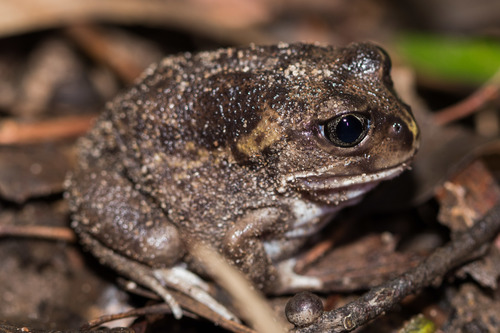
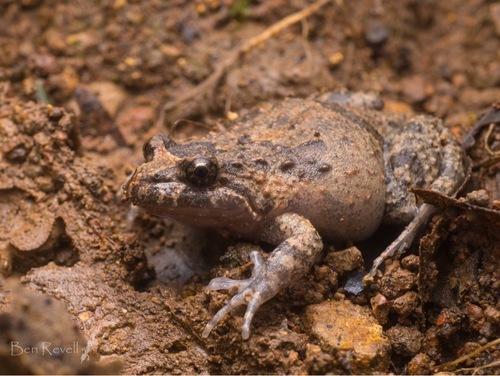
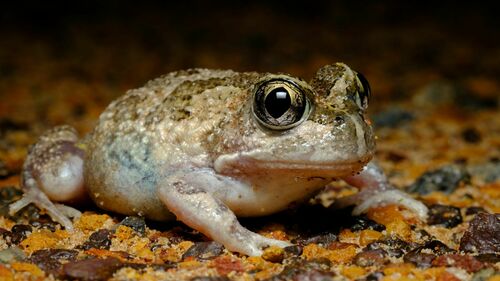
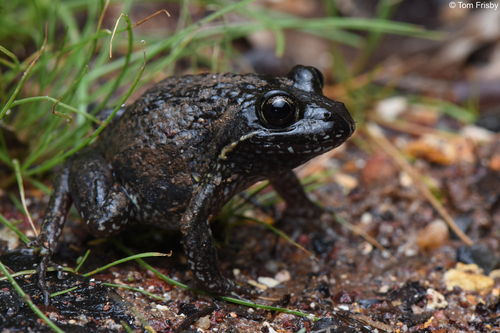
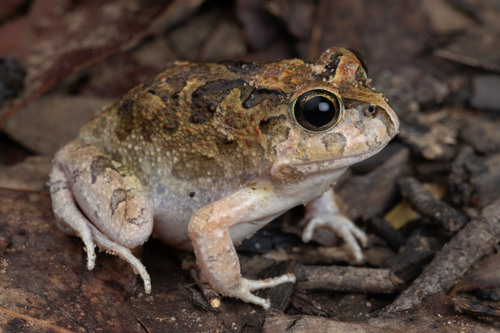
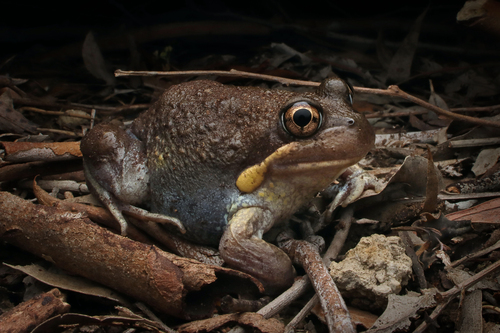
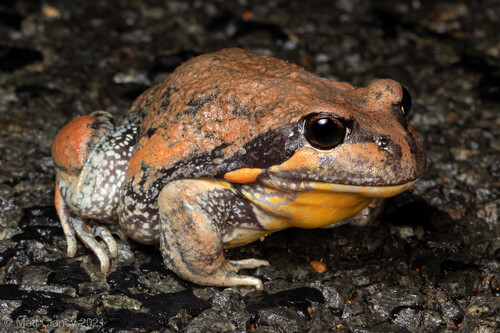
Its dorsal skin is mostly brown with irregular black markings and a bumpy texture, while its smooth underside ranges from pale to bright yellow.
Body Side Markings
Along the sides of its body, coloration runs from red-brown to fawn, marked with black and grey flecks, and a black stripe extends from the snout down the side of the body.
Eye Features
Its iris is dark-speckled gold, and its pupil is horizontal.
Foot Structure
The front feet are unwebbed, and the back feet are semi-webbed, with a large, shovel-shaped metatarsal tubercle on the underside of each back foot.
Toe Adaptations
Its strong toes have no discs and are primarily adapted for burrowing beneath the soil surface.
Egg Characteristics
Eggs of this species are pigmented, and are laid in a large foam mass located within flooded burrows surrounded by vegetation.
Tadpole Size
Compared to other banjo frog species, the tadpoles are quite large, growing up to 9.5 cm long.
Tadpole Coloration
They are dark brown or black, with gold clusters and dark grey fins.
Endemic Range
The Giant Banjo Frog is endemic to Australia, where it lives in the arid region of central New South Wales and northern Victoria.
Distribution Area
It is largely restricted to the Murray-Darling Basin and the floodplains of the Murray River, and its total area of occurrence covers approximately 214,800 km².
Emergence Pattern
This species spends most of its time underground, and only emerges after rain to feed and lay eggs.
Habitat Types
Its natural habitat is usually located near freshwater floodplains, marshes, swamps and ponds, but it can also be found in dry temperate forests, grassland and dry savanna.
Aquatic Life Cycle
Unlike many other arid-adapted amphibians, the Giant Banjo Frog spends a large portion of its life cycle in aquatic environments: eggs are laid in water, most often in flooded burrows, dams, swamps, and ponds, and tadpoles live in slow-moving or still water.
Preferred Wetlands
It occurs more frequently at permanent wetlands located away from the main Murray River channel, and that have more complex vegetation structure.
Breeding Season
Giant Banjo Frogs breed during spring and summer, and occasionally in autumn if rainfall is sufficient.
Egg Laying
Their reproductive cycle requires semi-permanent bodies of water; each female can lay up to 4000 eggs.
Egg Hatching
After spawning, eggs hatch within a few days, and newly hatched larvae tend to stay on the bottom of the water.
Larval Development
Larval development, from tadpole to mature frog, takes approximately two and a half months.