About Leucospermum lineare (Burm.fil.) R.Br.
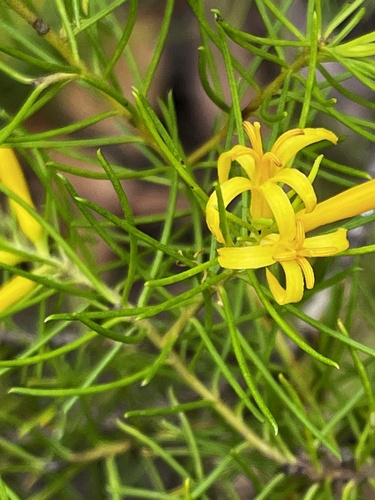
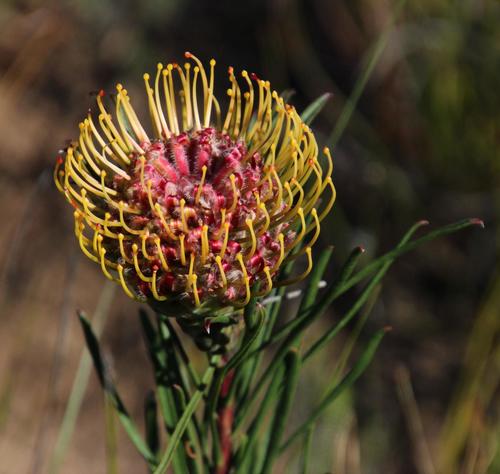
Leucospermum lineare is an upright evergreen shrub that grows up to 2 m (6.6 ft) high, or a sprawling shrub reaching 3–4 m (9.8–13.1 ft) in diameter. Flower-bearing branches are hairless, 2–5 mm (0.079–0.197 in) in diameter, and may be either upright or horizontally spreading. Its leaves are linear in shape, flat or with inward-rolled margins, 4–10 cm (1.6–3.9 in) long and 2–7 mm (0.079–0.276 in) wide. Leaves angle upwards, and have two or three teeth near the tip or lack teeth entirely. Flower heads are usually solitary or grouped in clusters of two or three, with a flattened egg shape and 8–9 cm (3.1–3.5 in) in diameter. They sit atop a stalk 1–4 cm (0.39–1.57 in) long. The common base of all flowers within a single head is a very slender, pointed cone, 2–3 cm (0.79–1.18 in) long and 3–5 mm (0.12–0.20 in) wide. Bracts subtending the entire flower head are oval with a pointed tip, around 1.5 cm (0.6 in) long, overlapping, rubbery in texture, softly hairy on the outer surface, and have a dense row of hairs along their edges. Bracts subtending individual flowers are oval with a pointed tip, around 1 cm (0.4 in) long and 5–6 mm (0.20–0.24 in) wide, rubbery in texture, and densely woolly at the base. The perianth is around 3 cm (1.2 in) long, S-shaped when opening, and ranges in color from pale yellow to orange. Its base is fused into a 7–8 mm (0.28–0.31 in) long tube, which has a slight bulge on one side and is smooth near the top. Anthers sit on a very short filament around 1 mm long. The style is 5–5.5 cm (2.0–2.2 in) long; near its upper end, the style is quadrangular and bends strongly toward the center of the flower head. It is topped by a slight thickening called the pollen presenter, which is obliquely oval with a pointed tip, around 1.5 mm (0.06 in) long, with the stigma-forming groove positioned obliquely at the very tip. The oblong ovary appears grey from a dense covering of minute soft hairs, is surrounded by 2 mm (0.079 in) long white hairs, and is subtended by four linear to awl-shaped nectar-secreting hypogynous scales around 2 mm (0.079 in) long. Leucospermum belongs to the subtribe Proteinae, which consistently has a basic chromosome number of twelve, with 2n=24. The natural range of L. lineare stretches from Bainskloof to the Klein Drakensteinberge. The horizontally sprawling branched form with golden yellow flowers is the most widespread. An upright form with deep orange flowers grows at Assegaaibos Kloof near French Hoek. This species grows mostly on mountainous sites with heavy gravelly clay soils, at elevations between 900 and 3,350 m (2,950–10,990 ft). These areas receive 750–1,250 millimetres (30–49 in) of average annual precipitation, most of which falls in winter. A small number of L. lineare populations grow on Table Mountain Sandstone, but even these sites are mostly underlain by weathered granite. Flowering occurs between July and January, with a peak in September and October. Flowers are pollinated by birds. Seeds drop from flower heads approximately 2 months after flowering. Each seed is covered by a soft, sweet, fatty layer called an elaiosome that emits pheromones sought after by ants. Native ant species collect the seeds and carry them to their underground nests, where they consume the elaiosome. The large, hard, smooth seed cannot be moved by ants after the elaiosome is eaten, so it remains underground, protected from fire and seed predators. This seed dispersal strategy is known as myrmecochory. Adult L. lineare plants do not survive wildfire, but seeds germinate quickly after fire passes through an area. Leucospermum lineare has been hybridized with L. cordifolium, L. tottum and L. vestitum. Selections of this species and its hybrids are cultivated as cut flowers and for use as garden plants.