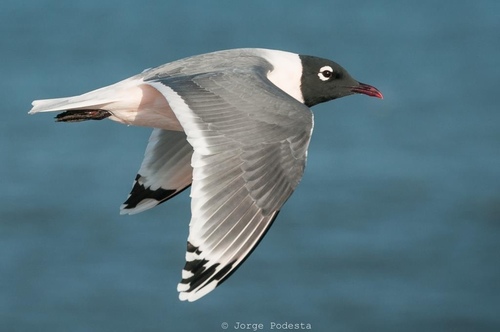
About Leucophaeus pipixcan (Wagler, 1831)
Breeding and Migration Range
This species, Leucophaeus pipixcan (Wagler, 1831), breeds in central provinces of Canada and adjacent northern states of the United States. It is a migratory gull, spending the winter in Argentina, the Caribbean, Chile, and Peru.
Breeding Adult Plumage
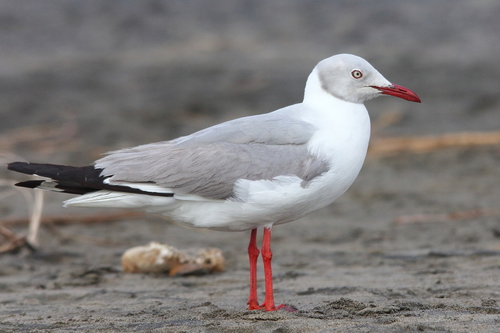
In summer, breeding adults have a white body, with back and wings that are much darker grey than all other similar-sized gulls, except for the larger laughing gull. The wing tips are black, with an adjacent white band, and both the bill and legs are red. Breeding adults have a black hood that is mostly lost during the winter.
Juvenile Plumage and Maturity
Juvenile gulls are similar in appearance to adults, but have less developed hoods and do not have the white wing band. They take three years to reach full maturity.
Species Measurements
Measured dimensions for the species are: length 12.6–14.2 inches (32–36 cm), weight 8.1–10.6 ounces (230–300 g), and wingspan 33.5–37.4 inches (85–95 cm).
Vagrant Occurrence Range
While the species is uncommon along the coasts of North America, it is found as a rare vagrant in northwest Europe, south and west Africa, Australia, and Japan.
Confirmed Vagrant Records
Confirmed rare records include one individual from Eilat, Israel, recorded in 2011 (Smith 2011), one from Larnaca, Cyprus, in July 2006, and another observed in Southern Romania, southeast Europe, at the start of 2017.
Breeding Habitat and Nests
For reproduction, this gull breeds in colonies near prairie lakes. Nests are built on the ground, and are occasionally constructed as floating nests.
Clutch and Incubation
Clutches contain two or three eggs, which are incubated for approximately three weeks.