About Larus glaucescens J.F.Naumann, 1840
Species Identification and Size Similarity
This gull species, Larus glaucescens (glaucous-winged gull), is a large bird that closely resembles its close relative the Western gull (L. occidentalis) in size and shape.
Standard Body Measurements
It measures 50–68 cm (20–27 in) in total length, has a wingspan of 120–150 cm (47–59 in), and ranges in body mass from 730–1,690 g (1.61–3.73 lb), with an average weight of around 1,010 g (2.23 lb). Standard measurements for this species are: wing chord 39.2 to 48 cm (15.4 to 18.9 in), bill 4.6 to 6.4 cm (1.8 to 2.5 in), and tarsus 5.8 to 7.8 cm (2.3 to 3.1 in).
Adult Breeding Plumage
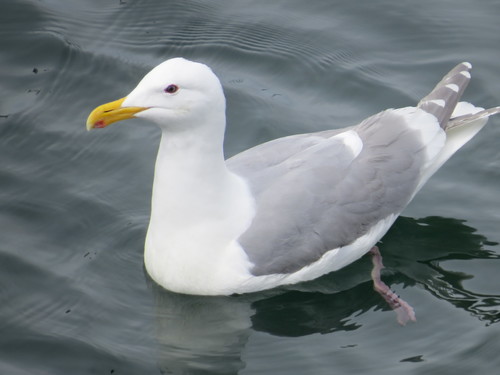
Adult breeding plumage includes a white head, neck, breast, belly, and tail. Its silver-gray wings and back form a mantle that is darker than the mantle of the Glaucous gull, and paler than the mantles of the Herring gull and Western Gull.
Wing and Limb Characteristics
The primary flight feathers (wingtips) are grey, usually matching the shade of the mantle. It has pink legs, a yellow beak with a red subterminal spot (the spot near the bill’s end that chicks peck to trigger regurgitative feeding), typically very dark irises, and pink orbital skin surrounding the eyes.
Head and Winter Plumage Features
Its forehead is somewhat flat. In winter, the head and nape darken and develop a mixed smudged or mottled pattern, while the bill becomes duller in color and often develops dark markings near the tip.
Juvenile Plumage
Juvenile glaucous-winged gulls are brown or gray with black beaks, and take four years to gain full adult plumage.
General Habitat Association
This species is almost always found not far from the ocean.
Resident and Breeding Range
It is a permanent resident along the Pacific coast from western Alaska to the coast of Washington, and also occurs in the Puget Sound region. It breeds in summer on the northwest coast of Alaska and in the Russian Far East.
Winter Distribution
During winter, it can be found along the coasts of California, Oregon, Baja California, Baja California Sur, and Sonora.
Typical Lifespan and Longevity Records
The typical expected lifespan of glaucous-winged gulls is around 15 years, though some individuals live much longer. One bird in British Columbia lived more than 21 years, and one in the U.S. state of Washington lived at least 22 years and 9 months.
Maximum Recorded Longevity
The maximum known longevity record for the species is more than 37 years, for a bird banded as a chick in British Columbia.
Vagrant Records in Western Palearctic
It is an exceptionally rare vagrant to the Western Palearctic region, with confirmed records from Morocco, the Canary Islands, and most recently Ireland in February and March 2016.
Vagrant Records in Britain
It has also been recorded in Britain during the winters of 2006/2007 and 2008/2009. The 2008/2009 record came from Saltholme Pools, Cleveland, and attracted hundreds of birdwatchers.