About Leopardus pardalis (Linnaeus, 1758)
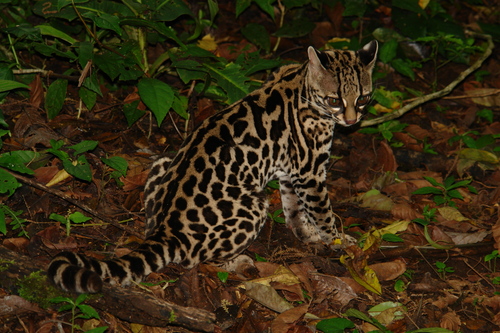
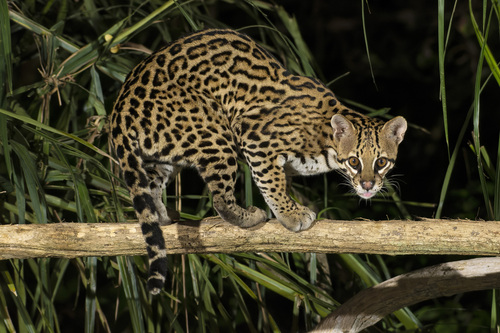
The ocelot, scientifically named Leopardus pardalis (Linnaeus, 1758), has distinct fur characteristics. Its fur has a background color ranging from creamy, tawny, yellowish, reddish gray to gray, covered extensively with solid black markings. Spots on the head and limbs are small, while markings on the back, cheeks, and flanks take the form of open or closed bands and stripes. A small number of dark stripes run straight from the back of the neck to the tip of the tail. The neck and undersides are white, and the insides of the legs have a few horizontal streaks. Its round ears each have a bright white spot. Fur length varies: it is around 0.8 cm (0.31 in) long on the belly, while guard hairs on the back are roughly 1 cm (0.39 in) long. The ocelot has a notably strong body odor. Every ocelot has a unique color pattern, which can be used to identify individual animals. Its eyes are brown, but glow with a golden hue when illuminated. It has 28 to 30 teeth, with a dental formula of 3.1.2–3.1 / 3.1.2.1. Its bite force quotient at the canine tip is 113.8. Only one ocelot has ever been recorded to have albinism, and the occurrence of this trait in ocelots is thought to be an indication of shrinking populations caused by deforestation. The ocelot is the largest member of the genus Leopardus, with a head-and-body length of 55 to 100 cm (22 to 39 in) and a tail that is 30 to 45 cm (12 to 18 in) long. It typically stands 40–50 cm (16–20 in) tall at the shoulder. Weights differ by sex: females weigh between 7 and 12 kg (15 and 26 lb), while males weigh between 8 and 18 kg (18 and 40 lb). Its footprint measures almost 5 cm × 5 cm (2.0 in × 2.0 in). The ocelot is often confused with the margay (Leopardus wiedii) and the oncilla (L. tigrinus), but it is noticeably larger and heavier than both species, and has a shorter tail. Though all three species have rosettes on their coats, the ocelot generally has a more blotched pattern; unlike the ocelot and margay, the oncilla has dark spots on its underbelly. Additional differences can be found in facial markings, tail appearance, and fur characteristics. The ocelot is similar in size to the bobcat (Lynx rufus), though larger individual ocelots have occasionally been recorded. The jaguar is notably larger and heavier than the ocelot, and has rosettes instead of the ocelot's spots and stripes. The ocelot's distribution spans from the southwestern United States to northern Argentina, and it can be found up to an elevation of 3,000 m (9,800 ft). In the United States, it currently lives in Texas and Arizona, and has been extirpated from Louisiana and Arkansas. Ocelot fossils have been discovered in Florida. The ocelot inhabits tropical forests, thorn forests, mangrove swamps, and savannas. In the Amazon rainforest, it prefers habitats that have sufficient prey and water, and tends to avoid other predators. It favors areas with dense forest cover and water sources, located far from roads and human settlement, and avoids steep slopes and highly elevated areas. In areas where ocelots live alongside larger predators such as cougars and humans, they adjust their active hours to avoid these threats, and seek out dense cover to avoid competitors. The ocelot can adapt well to different surroundings, so factors other than those listed above are not significant to its habitat choice. It shares a large portion of its range with the jaguar, jaguarundi, margay, oncilla, and cougar. The ocelot is typically solitary and is most active during twilight and at night. Radio-collared ocelots studied at the Cocha Cashu Biological Station in Peru rested during the day and became active as early as the late afternoon; they moved for between 3.2 and 17 hours until dawn, then returned to their dens. During the daytime, it rests in trees, in dens below large trees, or other cool, sheltered sites on the ground. It is agile when climbing and leaping, and escapes predators by jumping into trees. It is also an efficient swimmer. It scent-marks its territory by spraying urine. Male territories range from 3.5–46 km2 (1.4–17.8 sq mi), while female territories cover 0.8–15 km2 (0.31–5.79 sq mi). Female territories rarely overlap, and a single male's territory typically includes the territories of two to three females. Social interaction between males and females is minimal, though a small number of adults have been observed together even outside of mating periods, and some juveniles interact with their parents. Data from camera trapping studies confirms that multiple ocelot individuals deposit scat in one or more communal sites called latrines. Ocelots can be aggressive when defending their territory, and will even fight to the death. Ocelot population density tends to be high in areas with high rainfall, and decreases as latitude increases; the highest population densities have been recorded in the tropics. In 2014, the ocelot population density on Barro Colorado Island was estimated at 1.59–1.74 individuals per km2 (4.1–4.5 per sq mi), which is higher than the density of 0.984 per km2 (2.55 per sq mi) recorded in northwestern Amazon in Peru in 2010—the densest ocelot population recorded up to that point. Potential predators of adult ocelots in Texas include the cougar, coyote, and American alligator. Ocelot kittens are vulnerable to raptors such as the great horned owl, as well as bobcats, feral dogs, feral pigs, crotalid pit vipers, and colubrid constrictors. Studies have found that adult ocelots are vulnerable to predation by both cougars and jaguars, and decreasing water sources in Guatemala have led to more predatory encounters between ocelots and jaguars. During the mating season, both male and female ocelots produce a long-range "yowl" and a short-range "meow". Ocelots can mate at any time of year. The peak mating season varies by location: in Argentina and Paraguay, peaks have been observed in autumn, while in Mexico and Texas peaks occur in autumn and winter. Estrus lasts four to five days, and recurs every 25 days in non-pregnant females. A study in southern Brazil found that sperm production in ocelots, margays, and oncillas peaks in summer. When captive ocelots mate, they spend more time together, scent-mark extensively, and eat less. After a gestation period of two to three months, the female gives birth to a litter of one to three kittens. Dens are usually located in dense vegetation. A newborn ocelot kitten weighs 200–340 g (7.1–12.0 oz). Kittens are born with spots and stripes on a gray background; their coat color changes to golden as they grow older. A study in southern Texas found that a mother keeps a litter in a den for 13 to 64 days, and moves the young to two or three different dens. Kittens' eyes open 15 to 18 days after birth. Kittens begin leaving the den at three months old. They stay with their mother for up to two years, then disperse to establish their own territories. Compared to other felids, ocelots have a relatively longer interval between births and a smaller litter size. Captive ocelots can live up to 20 years.