About Leiothrix lutea (Scopoli, 1786)
Species Name and Size
Leiothrix lutea, commonly called the leiothrix, reaches approximately six inches in total length.
General Plumage Coloration
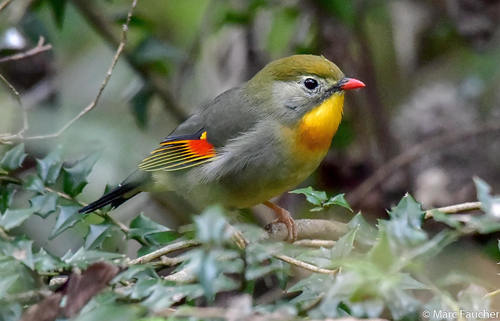
Its plumage is generally olive green, with a yellow throat and orange shading on the breast. It has a dull yellowish ring encircling the eye that extends toward the beak.
Wing and Tail Features
The edges of its wing feathers are brightly marked with yellow, orange, red and black; its forked tail is olive brown with a blackish tip.
Head and Neck Coloration
The cheeks and sides of the neck are bluish grey.
Sexual Dimorphism
Females are much paler than males, and lack the red wing patch found on males.
Flight Behavior
The leiothrix does not fly frequently, unless it is in open habitats.
General Behavior Traits
This bird is very active, an excellent singer, but also very secretive and difficult to observe.
Native Distribution Range
Its native distribution includes India, Bhutan, Nepal, Burma, and parts of Tibet.
Native Habitat and Elevation Range
In its native range, it is a hill forest bird that occurs in all types of jungle, though it prefers pine forests with shrubs; it can be found at elevations from near sea level up to around 7,500 feet (2,300 m).
Introduced Japanese Habitat Preference
In Japan, introduced populations prefer Abies and Tsuga forests with a dense bamboo understorey.
Hawaiian Islands Introduction History
The species was introduced to the Hawaiian Islands in 1918, and spread to all forested islands there except Lanai.
Hawaiian Population Trends
Its Oahu population crashed in the 1960s, and it disappeared from Kauai, but it is now common and increasing in numbers on Oahu.
Western Australia Introduction Outcome
It was released in Western Australia, but failed to become established there.
Great Britain Introduction Status
It was also introduced to Great Britain, where permanent establishment was long considered unsuccessful; however, a series of sightings from 2020 to 2022 in southern England suggests some small colonies may now be established.
Western Europe Introductions
It has been introduced to France, where it is now established in multiple areas; to Spain, where its population is increasing and it is spreading from Collserola Park; and to Portugal.
Japanese Naturalised Population History
In Japan, naturalised populations, likely of the nominate subspecies, have been recorded since the 1980s, and the species is now established in central and southwestern Japan.
Réunion Introduction Status
It is also established on the Mascarene island of Réunion.
Italian Introduction Status and Invasion Risk
It has been introduced to Italy, where three main populations are now found in Tuscany and Liguria, Latium, and Colli Euganei, and several areas are at high risk of invasion by the species.
Parasite Detection
In terms of behaviour and ecology, the avian malaria parasite has been detected in the blood of this species.