About Turdoides malcolmi (Sykes, 1832)
Common Name and Tail Feather Flight Trait
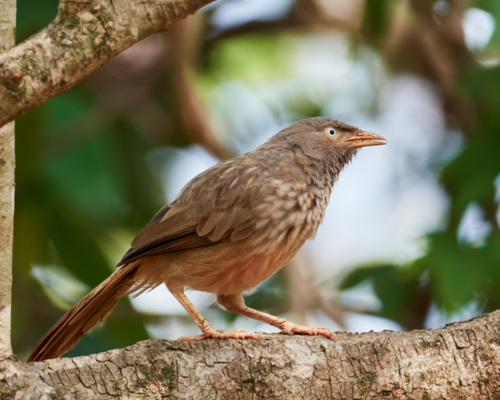
Turdoides malcolmi, the large brown long-tailed babbler, has creamy white outer tail feathers that are easily visible when it flies low over the ground with fluttery wing beats.
Head and Rump Plumage
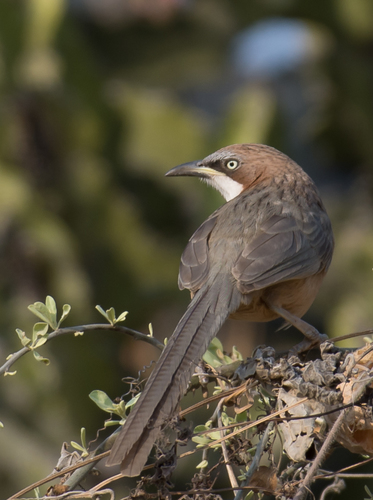
It has dark lores, a grey forehead with white shaft streaks on the feathers, pale grey rump and uppertail coverts.
Mantle Markings
Its mantle has dusky blotches and no shaft streaks.
Tail Feather Pattern Details
Three of its outer tail feathers are white, while the outer web of the fourth pair of tail feathers is white.
Wing, Iris, Bill and Tail Traits
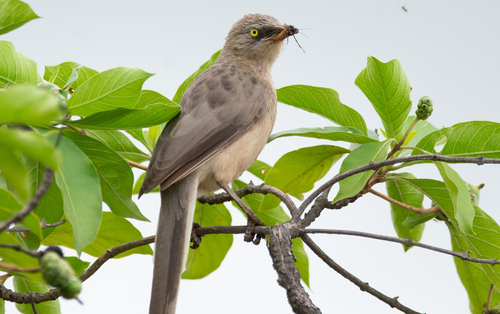
Its wings are darker brown, the iris is yellow, the upper mandible is dark brown, the lower mandible is yellowish, and the tail is faintly cross barred.
Abnormal Plumage Records
Abnormal specimens with albinism or leucism have been reported for this species.
Taxonomy and Etymology
The species was first described from the Deccan Plateau region, and its scientific name was given by Colonel W H Sykes to recognize the support he received from Major-General Sir John Malcolm.
Core Distribution Range
This species is found across the Indian subcontinent, south of the Himalayas and east of the Thar desert, extending as far east as Bihar.
Distribution Exclusions and Unconfirmed Records
It does not occur in Kerala, and records of its presence from the Sind area are unconfirmed.
Southern India Distribution Notes
It is also not found in the eastern dry zone of Tamil Nadu, though one exhausted specimen has been observed in Pondicherry.
Preferred Habitat
It primarily inhabits open dry scrub forest and cultivated areas.
Flock Social Behavior and Communication
Individuals of this species live in small flocks that stay in contact using loud nasal calls.
Predator Defense and Behavior
Flock members may work together to defend against predators, and individual birds have been observed attacking their own reflections.
Foraging Behavior
They forage on or near the ground in open scrub country, hopping and leaping across the ground to search for prey.
Play Behavior
Group members may also engage in play behaviour.
Diet Composition
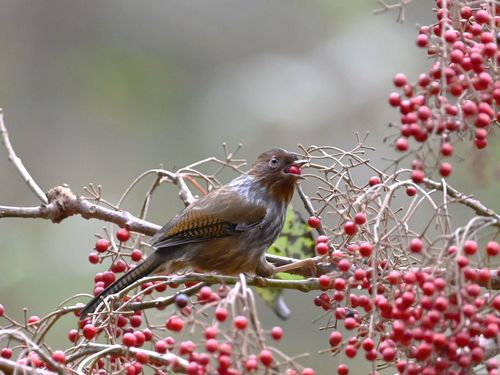
Their diet consists mainly of insects, but they also eat small lizards, molluscs, arachnids, seeds, grains, and berries.
Urban Habitat Presence
The species occurs in gardens within some Indian cities, including Pune and Ahmedabad, while in other cities like Bangalore it is only found on the outskirts of the expanding urban area.
Breeding Period
Turdoides malcolmi can breed year-round, but most breeding takes place during the rainy season from March to September.
Clutch Size
The typical clutch contains four eggs.
Nest Characteristics
The nest is a shallow cup built in a shrub, most often a thorny species.
Brood Parasitism
Nests of this species are regularly parasitized by the pied cuckoo and the common hawk-cuckoo.
Cooperative Breeding Hypothesis
It has been suggested that multiple females may lay eggs in a single nest and share incubation duties, but this hypothesis has not been verified.
Conservation Status and Local Threats
While the species is considered secure due to its wide distribution, some local populations are threatened by hunting for meat.
Parasite Record
An endoparasitic tapeworm, Vogea vestibularis, has been documented from this species.