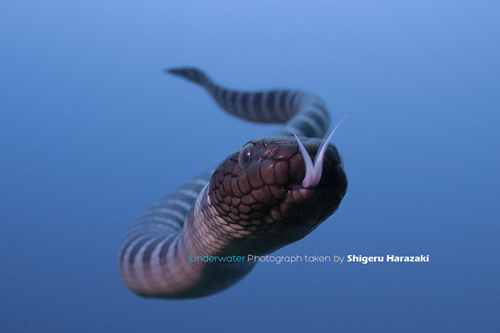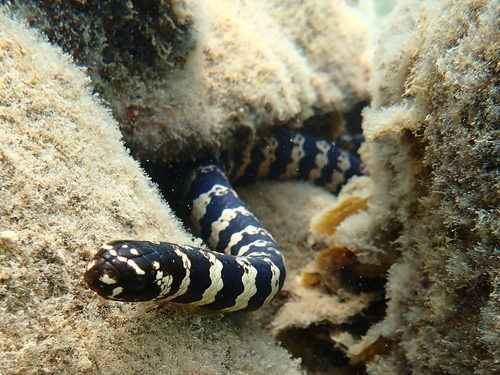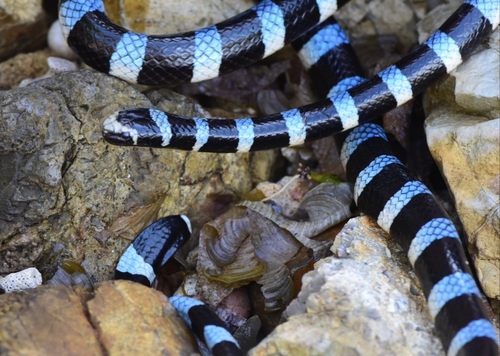
About Laticauda laticaudata (Linnaeus, 1758)
Ventral Scale Size
This species of snake has large ventral scales, which measure between one-third to more than one-half the width of the body.
Nasal Scale Features
Its nostrils are positioned laterally, and the nasal scales are separated by internasals.
Midbody Scale Rows
At midbody, 19 longitudinal rows of overlapping (imbricate) scales are present.
Prefrontal & Rostral Scales
No azygous prefrontal shield occurs, and the rostral scale is undivided.
Ventral Count Range
There are 225 to 243 ventrals.
Subcaudal Count Range
For subcaudals, males have 38 to 47, while females have 30 to 35; these ventral and subcaudal count records follow Smith 1943:443.
Lip Coloration
The upper lip of this snake is dark brown.
Total Length by Sex
Total length differs by sex: males reach a total length of 910 mm (36 in), and females reach 1,070 mm (42 in).
Tail Length
Tail length is similar for both sexes, at 110 mm (4.3 in).
Species Identification Traits
The combination of 19 scale rows and a dark brown upper lip can be used to distinguish this blue-lipped sea krait from other species in the genus Laticauda.
Broad Distribution Range
This species is distributed across the Indian and Western Pacific Oceans.
Specific Range Locations
Its recorded range includes the Bay of Bengal (Bangladesh, East India, Andaman & Nicobar Islands, Sri Lanka, Myanmar, Thailand), coasts from the Malay Peninsula to Indonesia, Timor-Leste, New Guinea, the Philippines, waters off Fujian and Taiwan, Japan, Polynesia, Melanesia, Solomon Islands, New Caledonia, Palau, Vanuatu, Fiji, and Queensland, Australia.
New Zealand Records
One specimen was found in Devonport, New Zealand in 2011, with another found there in January 2025; both individuals died shortly after being taken to Kelly Tarlton's Sea Life Aquarium.
Common Name Etymology
Because the blue-lipped sea krait is widespread throughout the Western Pacific, it is also commonly referred to as the common sea krait.
Land Activity
Sea kraits forage for prey in reef environments, then return to land to digest their food, mate, shed their skin, and lay eggs.
Temperature Shift Exposure
When moving between water and land, sea kraits experience rapid shifts in temperature.
Temperature Regulation
They typically reduce the impact of these shifts by seeking shelter away from direct sunlight.