About Dendroaspis polylepis Günther, 1864
Taxonomy and General Body Shape
The black mamba (Dendroaspis polylepis Günther, 1864) is a long, slender, cylindrical snake. It has a coffin-shaped head with a somewhat pronounced brow ridge and medium-sized eyes.
Adult Length
Most adult black mambas measure 2 to 3 meters (6 feet 7 inches to 9 feet 10 inches) in length, though some specimens have reached 4.3 to 4.5 meters (14 feet 1 inch to 14 feet 9 inches). It is the longest venomous snake species native to Africa, and the second-longest venomous snake species globally—only the king cobra grows longer.
Dental Structure
The black mamba is a proteroglyphous (front-fanged) snake, with fangs up to 6.5 millimeters (0.26 inches) long located at the front of the maxilla.
Tail Structure
Its tail is long and thin, with caudal vertebrae making up 17 to 25% of its total body length.
Body Mass
Reported average body mass for black mambas is around 1.6 kilograms (3.5 pounds), but one study of seven specimens found an average weight of 1.03 kilograms (2.3 pounds), ranging from 520 grams (18 ounces) for a 1.01-meter (3 feet 4 inches) specimen to 2.4 kilograms (5.3 pounds) for a 2.57-meter (8 feet 5 inches) specimen.
Dorsal Coloration
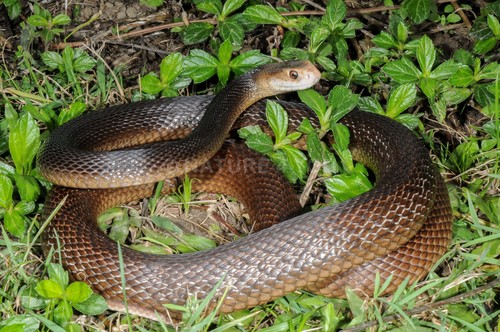
Body color varies widely among individuals, including shades of olive, yellowish-brown, khaki, and gunmetal, and black individuals are very rare. Some specimens have scales with a purplish sheen. Occasional individuals have dark mottling on their posterior body, which can form diagonal crossbands.
Underbelly and Mouth Color
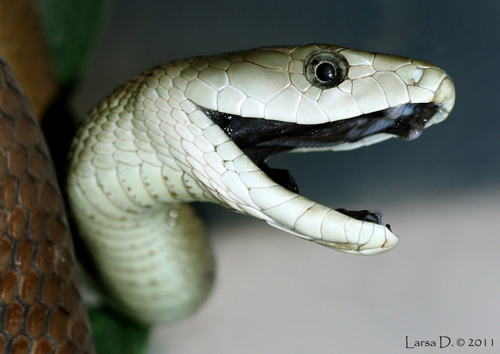
Black mambas have greyish-white underbellies. Their common name comes from the color of the inside of their mouth, which ranges from dark bluish-grey to nearly black.
Eye Coloration
Their eyes range from greyish-brown to shades of black, with a silvery-white or yellow ring surrounding the pupil.
Juvenile Coloration
Juvenile black mambans are lighter in color than adults—usually grey or olive green—and darken as they age.
Confirmed Distribution Range
The black mamba lives across a wide range of sub-Saharan Africa, with confirmed populations in Burkina Faso, Cameroon, the Central African Republic, the Democratic Republic of the Congo, South Sudan, Ethiopia, Eritrea, Somalia, Kenya, Uganda, Tanzania, Burundi, Rwanda, Mozambique, Eswatini, Malawi, Zambia, Zimbabwe, Botswana, South Africa, Namibia, and Angola.
Disputed Distribution
Its presence in parts of West Africa is disputed. Two observations of black mambas in Senegal's Dakar region (one in 1954, and a second in 1956) have never been confirmed, so the species' distribution in this area remains unconfirmed.
Habitat Preferences
It prefers moderately dry habitats such as light woodland, scrub, rocky outcrops, and semi-arid savanna, but also lives in moist savanna and lowland forests.
Altitudinal Range
It is not commonly found above 1,000 meters (3,300 feet) in altitude, though it has been recorded at 1,800 meters (5,900 feet) in Kenya and 1,650 meters (5,410 feet) in Zambia.
Conservation Status
The IUCN Red List classifies the black mamba as a species of least concern, due to its large range across sub-Saharan Africa and no documented population decline.
Locomotion and Shelter Sites
The black mamba is both terrestrial and arboreal. When moving on the ground, it holds its head and neck raised, and typically shelters in termite mounds, abandoned burrows, rock crevices, and tree cracks.
Activity Pattern
It is diurnal; in South Africa, it has been recorded basking between 7 and 10 am, and again from 2 to 4 pm, and may return to the same basking site every day.
General Temperament
The black mamba is skittish, often unpredictable, agile, and fast-moving. In the wild, it rarely tolerates humans approaching closer than roughly 40 meters (130 feet). When it senses a threat, it retreats into brush or a hole.
Threat Display Behavior
When cornered or confronted, it usually performs a threat display: gaping to show its dark mouth, flicking its tongue, hissing, and spreading its neck into a hood similar to that of cobras in the genus Naja. During a threat display, any sudden movement from an intruder can trigger a series of rapid strikes that cause severe envenomation.
Strike Characteristics
The black mamba's large size lets it lift its head far from the ground, allowing it to strike upwards with as much as 40% of its body length, so bites to humans often occur on the upper body.
Aggression Misconception
Its reputation as an aggressive animal that readily attacks is exaggerated; attacks usually only happen when the snake is provoked by perceived threats that block its movement and retreat.
Maximum Speed
Its reputed maximum speed is also exaggerated; it cannot move faster than 20 km/h (12 mph).
Breeding Season Timing
Black mamba breeding season runs from September to February, following the temperature drop that occurs between April and June.
Male-Male Competition
Rival males compete by wrestling, intertwining their bodies and struggling with their necks to subdue one another, a behavior that observers have sometimes mistaken for courtship.
Mating Behavior
During mating, the male slithers over the female's dorsal side while flicking his tongue. The female signals she is ready to mate by lifting her tail and remaining still. The male then coils around the posterior end of the female and aligns his tail ventrolaterally with the female's.
Copulation Duration
Intromission can last longer than two hours, and the pair stays mostly motionless except for occasional spasms from the male.
Reproductive Mode and Clutch Size
The black mamba is oviparous; females lay clutches of 6 to 17 eggs.
Egg Dimensions
The eggs are elongated oval, typically 60 to 80 mm (2.4 to 3.1 in) long and 30 to 36 mm (1.2 to 1.4 in) in diameter.
Hatchling Size and Growth
When they hatch, young black mambas are 40 to 60 cm (16 to 24 in) long. They grow quickly, reaching 2 m (6 ft 7 in) in their first year.
Juvenile Traits
Juvenile black mambas are very wary and are just as deadly as adults.
Lifespan
The black mamba has been recorded to live up to 11 years, and may live longer than that.