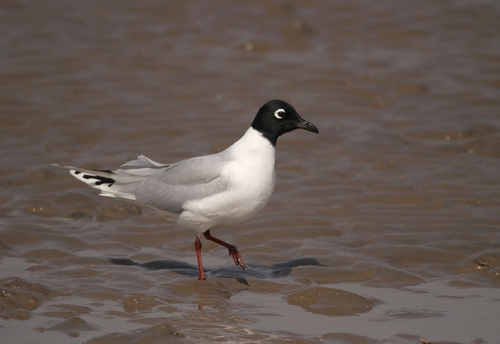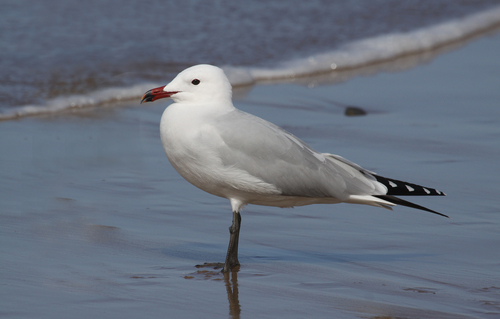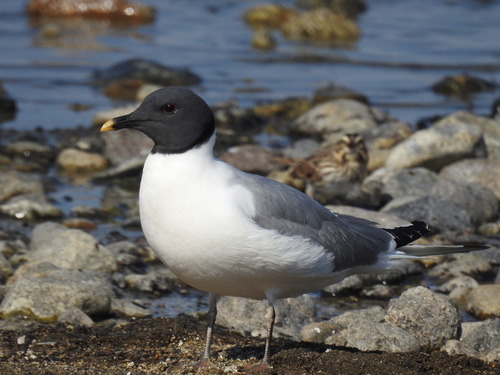
About Xema sabini (Sabine, 1819)
Sabine's gull (scientific name Xema sabini (Sabine, 1819)) is a small gull species.
Size Measurements
It measures 27 to 33 cm (10+1⁄2–13 in) in body length, weighs 135 to 225 g (4+3⁄4–7+15⁄16 oz), and has a wingspan of 81 to 87 cm (32–34+1⁄2 in).
Physical Features
Its wings are long, thin, and pointed; its bill is around 2.5 cm (1 in) long, black with a yellow tip; and its white tail is slightly forked.
Identification Notes
The species is easy to identify by its striking wing pattern, though it can be confused with immature black-legged kittiwakes when seen at long range.
Adult Plumage
Adult Sabine's gulls have a pale grey back and wing coverts, four black outer primary flight feathers, and white inner primaries and secondaries. During the breeding season, the adult's pale hood darkens to dark grey, with a narrow black collar at the base of the hood.
Juvenile Plumage
Young birds have a similar three-coloured wing pattern, but brown replaces the grey seen in adults, and their tail has a black terminal band. Juveniles require two years to develop full adult plumage.
Moult Pattern
Sabine's gulls have an unusual moult pattern for gulls. Fledged young birds keep their juvenile plumage through autumn, and do not start moulting into their first winter plumage until they arrive at their wintering grounds.
Adult Moult Schedule
For adults, complete moult occurs in spring before spring migration, and a partial moult takes place in autumn after they return to the wintering area. This schedule is the reverse of the typical moult pattern for most gulls.
Vocalization
The call of Sabine's gull is very high-pitched and squeaking.
Breeding Range
Sabine's gulls breed in the Arctic, with a near-circumpolar distribution across the northernmost parts of North America and Eurasia.
Migration Distance
They migrate south to the Southern Hemisphere each autumn, travelling 32,000–39,000 km per year, which is the longest annual migration of any gull species.
Eastern Population Wintering Range
Populations from Svalbard, Greenland, and eastern Canada usually cross the Atlantic Ocean via the westernmost coasts of Europe (including Ireland, western Great Britain, northwest Spain, and Portugal) and northwest Africa (including Morocco), to winter off southwestern Africa in the cold waters of the Benguela Current off Namibia and South Africa.
Eastern Migration Stopovers
During their southward flight, the birds spend around 45 days feeding offshore in the Bay of Biscay. They may also stop at different island chains, including the Azores and Canary Islands.
Vagrant Occurrences
Occasionally, individual Sabine's gulls are seen on other coastlines, such as the coasts of the North Sea, and in North America along the northeastern United States and Eastern Seaboard, most typically after autumn storms.
Western Population Wintering Range
Most populations from western North America and Siberia winter at sea in the southeast Pacific Ocean, travelling to islets and outcrops off the west coast of South America, ranging from the Galápagos Islands to northern Chile. In this region, a consistent food supply is supported by the cold waters of the Humboldt Current.
Western Migration Stopovers
Along their migration route, these Sabine's gulls stop along the West Coast of the United States, and the Pacific coasts of Mexico and Central America; they can be observed on the California coast and along the Pacific coast of Baja California and Baja California Sur, Mexico.
Inland Migration Records
Sabine's gulls are recorded often enough inland in North America, Europe, and even Siberia that the species is said to carry out "cross-continental migration" in addition to migration at sea.