About Chlidonias niger (Linnaeus, 1758)
Adult Size Measurements
Adults of Chlidonias niger measure 25 cm (10 in) in length, have a 61 cm (24 in) wingspan, and weigh 62 g (2+1⁄8 oz).
Adult Bill and Leg Features
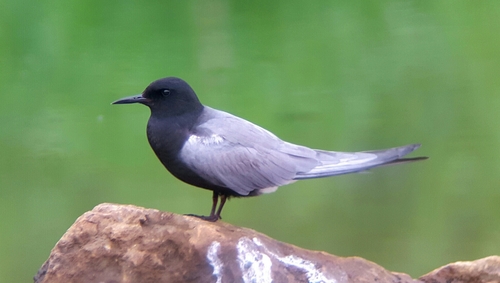
They have short dark legs and a short, weak-looking black bill that measures 27 mm (1+1⁄16 in), nearly as long as the head. The bill is also described as long, slender, and slightly decurved in appearance.
Adult Plumage (Body)
Adults have a dark grey back, a white forewing, a black head, neck (which occasionally gains a grey suffusion in adults) and belly, a black or blackish-brown cap that merges in color with the ear coverts to form an almost complete hood, a light brownish-grey 'square' tail, and a white face.
Adult Facial Markings
There is a large dark triangular patch in front of the eye.
Juvenile Plumage (Collar)
Juveniles have a fairly broad white collar.
Juvenile Breast Markings
There are greyish-brown smudges on the sides of the white breast, which extend downwards from the plumage of the upperparts. These smudges vary in size and are not noticeable.
Non-breeding Plumage (Head and Body)
In non-breeding plumage, most of the black plumage is replaced by grey, leaving only the cap unchanged. The upperparts' plumage becomes drab with pale feather edges, and the rump is brownish-grey.
Subspecies Distinction
The North American subspecies C. n. surinamensis can be distinguished from the European nominate form across all plumages, and some authorities consider it a separate species.
Flight Appearance
In flight, this bird has a slender build. Its wing beats are full and dynamic, and its flight is often erratic as it dives toward the water surface to feed, similar to other tern species.
Vocalizations
Its call is described as a high-pitched "kik", and a large flock of this species has been called deafening.
Breeding Habitat Range
The breeding habitat of Chlidonias niger is freshwater marshes across most of Canada, the northern United States, and much of Europe and western Asia.
Nesting and Clutch
They typically nest either on floating vegetation in a marsh or on the ground very close to water, and lay 2 to 4 eggs per clutch.
Historical English Population
In England, black terns were abundant in the eastern Fens, especially in Lincolnshire and Cambridgeshire, until the early 1800s. Welsh naturalist Thomas Pennant, describing a 1769 visit to Lincolnshire, mentioned 'vast flocks' of black terns that 'almost deafen one with their clamors'.
English Population Extinction
Extensive drainage of the species' breeding grounds eliminated the English population by around 1840.
UK Recolonization Attempts
Intermittent attempts by black terns to recolonize England have been unsuccessful; there were only a handful of breeding records in England and one in Ireland during the second half of the twentieth century.
North American Migration
North American black terns migrate to the coasts of northern South America, and some migrate to the open ocean.
Old World Migration
Old World black terns spend the winter in Africa.
Foraging Behavior
Unlike "white" terns of the genus Sterna, these birds do not dive for fish. Instead, they forage while flying, picking up food items at or near the water surface or catching insects mid-flight.
Diet
They mainly eat insects and fish, and also eat amphibians.