About Larus brachyrhynchus Richardson, 1831
Size Measurements
The short-billed gull (Larus brachyrhynchus Richardson, 1831) measures 40–45 cm (16–18 in) in length, with a wingspan of 100–120 cm (39–47 in). It is smaller than other gulls in the Common gull complex, with a shorter bill and longer wings.
Wing Morphology In Flight
Relative to its short body, its wings look long and narrow when in flight.
Breeding Plumage
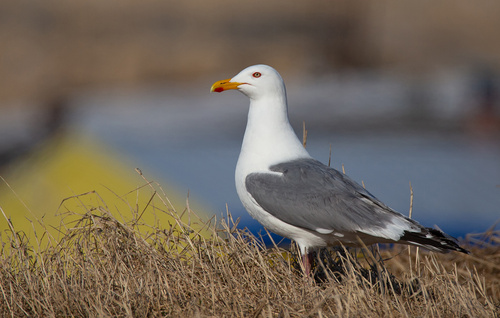
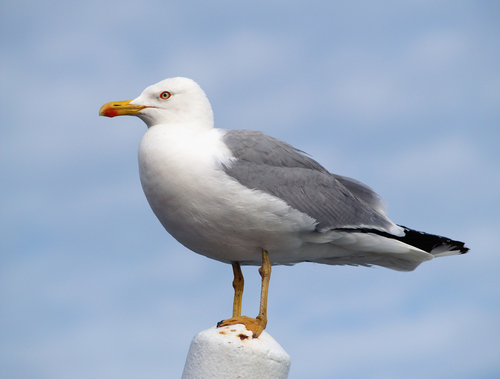
In breeding plumage, adult short-billed gulls have a white head, pale eyes surrounded by red orbital skin, and unmarked yellow legs and bill.
Non-breeding Plumage
In winter, the head has brown mottling, the orbital skin turns grayish, and the bill becomes duller with a faint dark marking.
Primary Feather Markings
When flying, the two outermost primary feathers (p9 and p10) have noticeable white spots called 'mirrors'. Between p5 and p8, the primaries have white 'tongue tips' that form a 'string of pearls' that transitions to the broad white trailing edge of the wing. Most individual birds have a black marking on p4.
Common Gull Comparison
Compared to the short-billed gull, common gulls have a larger bill and shorter wings. Common gull wingtips have more extensive black, smaller mirrors on p9-10, a narrower trailing edge, and typically lack both black markings on p4 and the white tongue tip on p8.
Plumage Maturation Timeline
Short-billed gulls require 3 years to develop full breeding plumage.
Juvenile Plumage
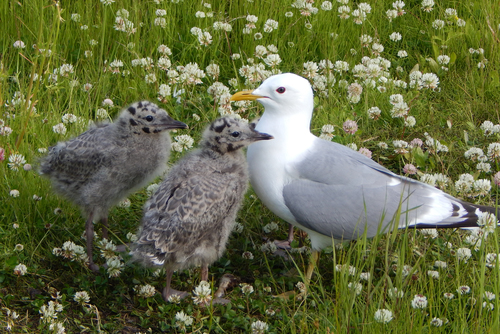
Juveniles are brownish overall with dark brown wingtips, and have darker, more smudged markings on the head and neck. This contrasts with juvenile common gulls, which are paler with finer markings, and more closely resemble ring-billed gulls at this life stage.
First-year Winter Plumage
Many first-year short-billed gulls keep their juvenile plumage through the winter, though some grow grayish saddle feathers mixed in with their original juvenile feathers. By the first winter, the bill becomes pink at the base with a black tip.
Second-year Plumage
Second-year short-billed gulls resemble adults, but may have brown wing covert feathers and black markings on the tertials, and only have a white spot in the form of the p10 mirror on the wingtip.
Third-year Plumage
Third-year birds are also similar to adults, but may have dark markings on the primary coverts, secondaries, underwing and tail, alongside more extensive black on the wingtips.
Breeding Range
The short-billed gull breeds in colonies along coastal areas and inland wetlands, mainly in Alaska and Northwest Canada.
Winter Distribution
Most individuals winter along the Pacific coast as far south as the Sacramento Valley, and are found less frequently as far south as Baja California, and inland to the Northern Rockies and Ontario.
Vagrant Records
It is a very rare visitor to eastern North America and a vagrant to east Asia. There are two confirmed records of short-billed gulls in Europe: one in the Azores in 2003, and one in the Faroe Islands in 2026.