About Creagrus furcatus (Néboux, 1842)
Sexual Dimorphism
The swallow-tailed gull, scientifically named Creagrus furcatus (Néboux, 1842), has no differences in structure or plumage between males and females.
Breeding Season Plumage
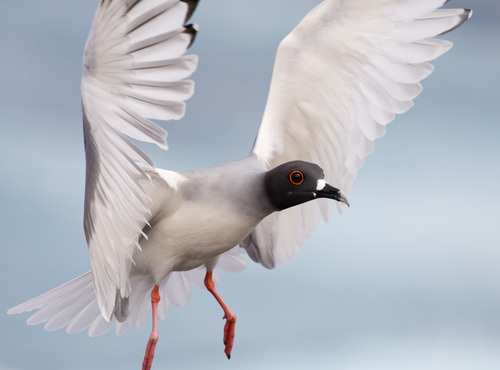
During the breeding season, adult individuals have a black-feathered head and a bright red fleshy rim surrounding each eye.
Non-breeding Season Plumage
Outside of the breeding season, their head is white, and the eye rim changes to black.
Body Plumage Details
This species has a grayish upper breast, a gray mantle, and black wingtips.
Bill Characteristics
Its bill is mostly black, with a distinct contrasting white tip.
Breeding Distribution
For distribution and habitat, the swallow-tailed gull is a near-endemic breeding bird of the Galápagos Islands, though a small number of pairs nest on Malpelo Island off the coast of Colombia.
Non-breeding Habitat and Migration
When not breeding, it is completely pelagic, flying and hunting over open oceans, and migrates eastward to the coasts of Ecuador and Peru.
Feeding Habit Uniqueness
In terms of feeding behavior, the swallow-tailed gull is unique among gulls for feeding exclusively at night.
Prey Items
It feeds mostly on fish and squid, which rise to the surface at night to feed on plankton.
Colony Departure Behavior
It leaves its colony as a flock at dusk, accompanied by a great deal of calling and display.