About Larus vegae Palmén, 1887
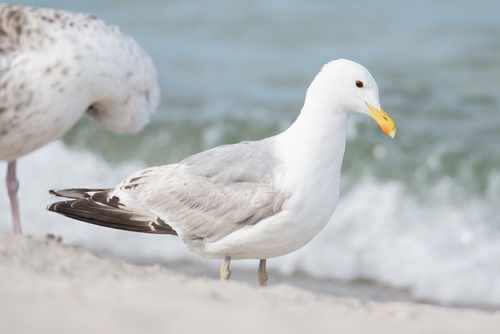
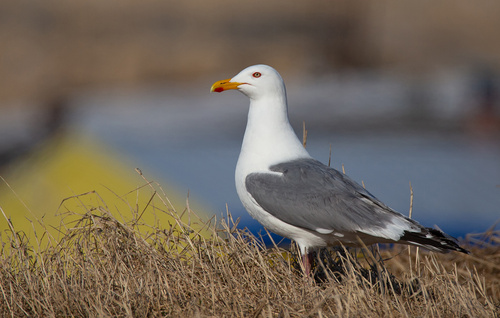
Vega gull (Larus vegae Palmén, 1887) resembles the herring gull, but has slightly darker grey plumage on its upper body.
Winter Plumage Features
In winter, the head of the Vega gull is heavily streaked with brown; this streaking is especially prominent on the back and sides of the neck, forming a collar. Its legs are usually bright pink.
First- and Second-Winter Plumage
First- and second-winter Vega gulls are darker than similar-looking Mongolian gulls, most noticeably on the crown of the head, where even first- and second-winter Mongolian gulls are paler. Almost the entire body of first- and second-winter Vega gulls has darker brown flecks and streaks.
Similar Species Comparison
Winter adult Vega gulls are often confused with the very similar slaty-backed gull (L. schistisagus) and western gull (L. occidentalis), but the grey plumage of the Vega gull is lighter than that of both of these similar species.
Head and Bill Characteristics
The Vega gull's eye colour is variable, but tends to be dark, with a red orbital ring. Its bill is yellow with a red spot, except in first- and second-winter gulls, where the bill may be almost entirely dark grey to black; the dark grey portion shrinks as the bird reaches maturity.
Subspecies Variation
Vega gulls in the northwestern part of their breeding range are paler on their upper body, and are sometimes treated as a separate subspecies: Birula's gull (Larus vegae birulai).
Breeding and Wintering Range
Vega gulls breed in northeastern Siberia, and migrate south to winter in Japan, Korea, eastern China, and Taiwan. They are seen regularly on St. Lawrence Island and in Nome, Alaska, and may breed there.
North American Occurrence Records
There are also records of Vega gulls from other parts of western Alaska, and a few photo-documented records from Washington and California.
Winter Habitat
Within their winter range, they are typically found in harbours, on rocky shores, and at river mouths.