About Cephalorhynchus eutropia (Gray, 1846)
Scientific Nomenclature and Body Length
The Chilean dolphin (scientific name: Cephalorhynchus eutropia (Gray, 1846)) is a small cetacean, reaching around 1.7 metres (5 ft 7 in) in length.
Weight and Sexual Dimorphism
Adult individuals can weigh up to 60 kg, and females are slightly larger than males.
Body Build
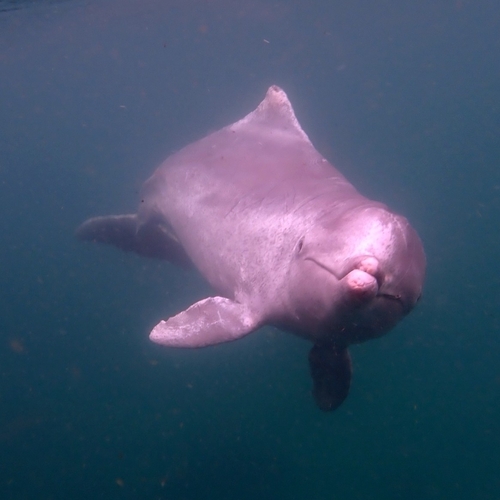
This species has a thick, stocky build, with a girth that can measure up to two-thirds of its total body length. Because of its small, thick shape, it is often mistaken for other types of porpoises.
Fin and Flipper Proportions
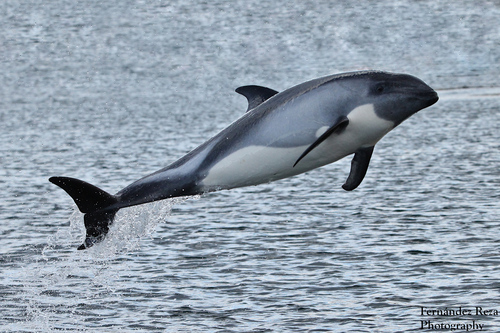
Compared to other dolphins, its dorsal fin and flippers are small relative to its body size.
Body Coloration
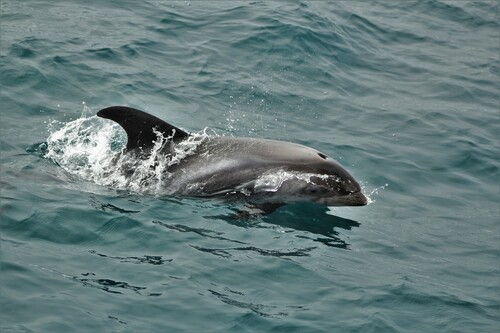
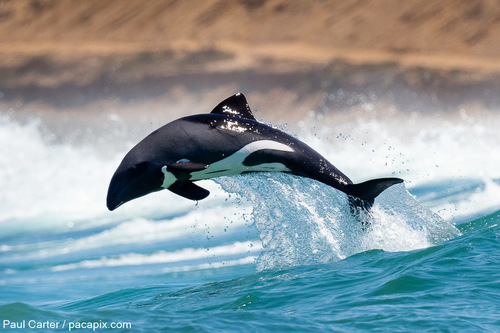
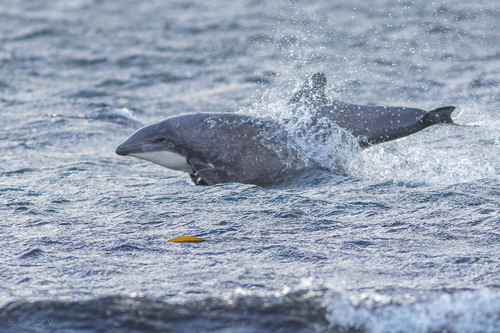
The throat, underside, and the part of the flippers closest to the body are white, while the rest of the body is a mix of grey shades. A black line connects the blowhole, eyes, and dorsal fin.
Dentition
It has 28 to 34 pairs of teeth in the upper jaw, and 29 to 33 pairs of teeth in the lower jaw.
Facial and Tail Features
The two eyes are positioned at the ends of the mouth lines, which creates the appearance of a smile. The tail has a characteristic notch in its center.
Distinguishing Morphological Traits
The most distinct features of the Chilean dolphin are its short beak, round dorsal fin, and rounded flippers.
Population Data Uncertainty
Very little research has been done on the Chilean dolphin, so its total wild population is not known with certainty. Current estimates place the total remaining wild population at fewer than 5,000 individuals.
Endemic Range and Migration
This species is endemic to the coast of Chile, and is not found anywhere else in the world. It is not believed to migrate.
Latitudinal Distribution
It occupies a wider range of latitudes than other species in the Cephalorhynchus genus, spanning from Valparaíso at 33°S to Cape Horn at 55°S.
Northern Habitat Group Size
Larger groups of 20 to 50 individuals are found in the northern areas of its habitat, including one reported pod that stretched 24 kilometres (15 mi) long.
Southern Habitat Population Concentration
Most of the species’ total population lives in the southern regions of its range.
Preferred Shallow Water Habitats
Chilean dolphins prefer shallow water habitats, especially areas close to rivers and regions with high tides.
Habitat Vulnerability
Their close association with riverine and estuarine ecosystems makes them extremely vulnerable to habitat loss from both coastal and upstream river basin degradation. Their relatively limited distribution and requirement for specific environmental conditions make the species particularly susceptible to population loss, even in the most remote areas.
Regional Habitat Preferences
In the northern parts of their range, Chilean dolphins live in bays and estuaries along more exposed coastlines, while in the southern regions they prefer fjords and channels. They are commonly seen in bays, channels, near rivers, and in areas with larger tidal changes.
Salinity Tolerance
Most individuals live in salt water, but they have also been spotted in freshwater rivers.
Depth and Shore Proximity
They prefer shallow waters that are usually less than 20 meters deep, and tend to stay within 500 meters of the shore.
Pod Localization
Research has found that Chilean dolphin pods are highly localized, and environmental factors often act as barriers between separate pods.
Reproduction Research Status
Little is known about the reproduction of the Chilean dolphin.
Mating and Birthing Periods
Mating takes place in early winter, and females give birth to offspring in spring.
Calving Frequency
Females usually produce one calf every two to three years.
Maturity Age
Calves reach full maturity between 5 and 9 years of age.
Calf Rearing
Young calves are cared for by their mothers, and learn to forage and navigate social behavior from them.