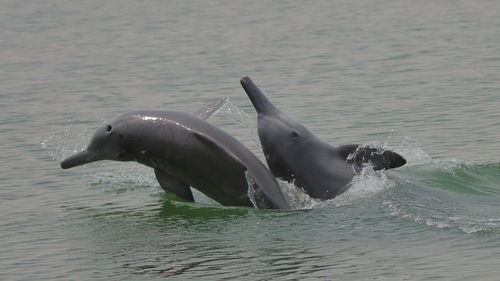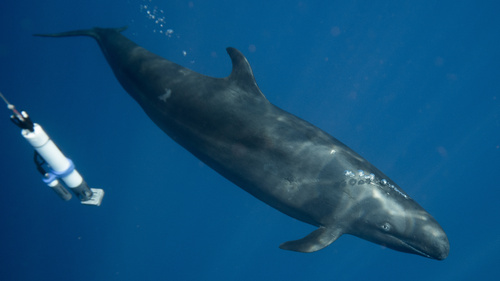
About Pseudorca crassidens (Owen, 1846)
Taxonomic Naming
The scientific name of the false killer whale is Pseudorca crassidens (Owen, 1846).
General Size Ranking
False killer whales are large marine predators, and they are the fourth-largest extant species of oceanic dolphin. Only orcas and the two species of pilot whales exceed them in size.
Adult Size Dimorphism
Males are around 10 to 15 percent larger than females: females reach a maximum length of 5 m (16 ft) and maximum weight of 1,200 kg (2,600 lb), while males reach a maximum length of 6 m (20 ft) and maximum weight of 2,300 kg (5,100 lb).
Newborn Size
Newborn false killer whales measure between 1.5–2.1 m (5–7 ft) long.
Coloration
Their coloration is black or dark gray, with a slightly lighter shade on the underside.
Body and Head Shape
They have a slender body with an elongated, tapered head that has no beak.
Fin and Flipper Structure
Their dorsal fin is sickle-shaped, and their flippers are narrow, short, and pointed, with a distinctive bulge on the flipper's leading edge.
Body Temperature
Their body temperature ranges from 36–37.2 °C (96.8–99.0 °F), and it rises when the animal is active.
Dentition
Their teeth are conical; there are 14–21 teeth in the upper jaw and 16–24 teeth in the lower jaw.
Physical Maturity
False killer whales reach physical maturity between 8 and 14 years of age.
Maximum Recorded Age
The maximum recorded age in captivity is 57 years for males and 62 years for females.
Sexual Maturity
Sexual maturity occurs between 8 and 11 years of age.
Calving Interval
In one observed population, calving happens at 7-year intervals.
Calving Season
Calving can occur at any time of year, though it most often takes place in late winter.
Gestation and Lactation Periods
Gestation lasts approximately 15 months, and lactation lasts between 9 months and 2 years.
Post-Menopause Lifespan
After menopause, which typically occurs between 45 and 55 years of age, false killer whales have a substantial remaining lifespan, similar to pilot whales.
Echolocation Ability
As a toothed whale, the false killer whale uses echolocation to navigate and locate prey, creating sound with the melon organ located in its forehead.
Melon Sexual Dimorphism
The melon is larger in males than in females.
General Geographic Range
False killer whales have a widespread distribution across tropical and semitropical oceans.
Temperate Water Occurrence
Individuals have been found in temperate waters, but these sightings are likely of stray animals, or associated with warm water events.
Latitudinal Range Limits
The species generally does not range further north than 50°N or further south than 50°S.
Typical Habitat
It usually lives in the open ocean and deep-water areas, though it may regularly visit coastal areas near oceanic islands.
Regional Distinct Populations
Two distinct populations live in the seas near the Hawaiian Islands and in the eastern North Pacific.
Global Population Status
False killer whales are thought to be common globally, but no total global population estimate has been made.
Regional Population Estimates
The population in the Eastern Pacific is probably in the low tens-of-thousands, and there are around 16,000 individuals near China and Japan.
Hawaiian Population Trend
The population around Hawaii has been declining.
General Predator Habitat
False killer whales are active predators that live in tropical and subtropical waters.
General Prey Range
They generally hunt a wide variety of squid and fish of many different sizes during daylight hours.
Common Fish Prey
They typically target large fish species such as mahi-mahi, wahoo and tuna.
Marine Mammal Prey
They are also known to prey on marine mammals, including some species of dolphins and whales.
Captive Feeding Rate
In captivity, false killer whales eat 3.4 to 4.3 percent of their body weight each day.
Observed Shark Predation
A 2016 video recorded near Sydney captured a group of false killer whales hunting a juvenile shark.
Feeding Behavior Traits
The species sometimes discards the tail, gills, and stomach of captured fish, and pod members are known to share food with one another.
Purse-Seine Fishing Prey Targeting
In the Eastern Pacific, false killer whales have been observed targeting smaller dolphins during tuna purse-seine fishing operations.
Large Whale Predation Records
They have been recorded attacking sperm whales (Physeter macrocephalus), and there is one recorded instance of a false killer whale attacking a humpback whale (Megaptera novaeangliae) calf.
Known Predators
Killer whales are known to prey on false killer whales.
Potential Predators
Large sharks may also pose a threat to false killer whales, though there are no documented cases of this.
Known Parasite Diversity
False killer whales are known to host a wide range of parasites: the trematode Nasitrema in the sinuses, the nematode Stenurus in the sinuses and lungs, an unidentified crassicaudine nematode in the sinuses, the stomach nematodes Anisakis simplex and Anisakis typica, the acanthocephalan worm Bolbosoma capitatum in the intestines, the whale lice Syncyamus pseudorcae and Isocyamus delphinii, and the whale barnacle Xenobalanus globicipitis.
Stranding Parasite Infestations
Some stranded false killer whales have had large infestations of Bolbosoma, including 1976 and 1986 strandings in Florida.