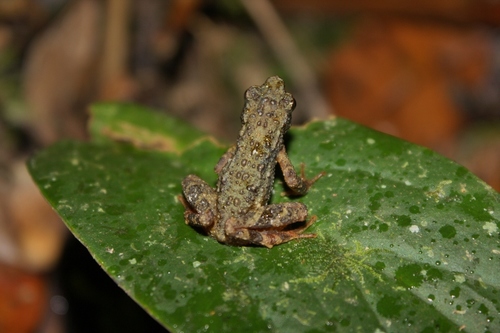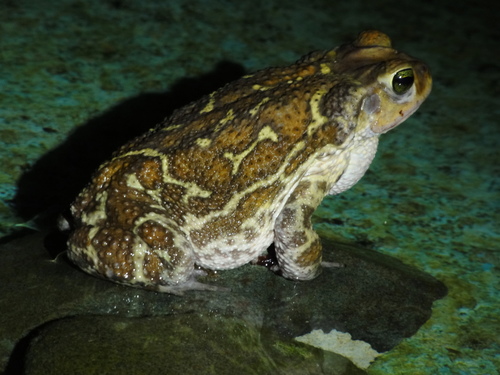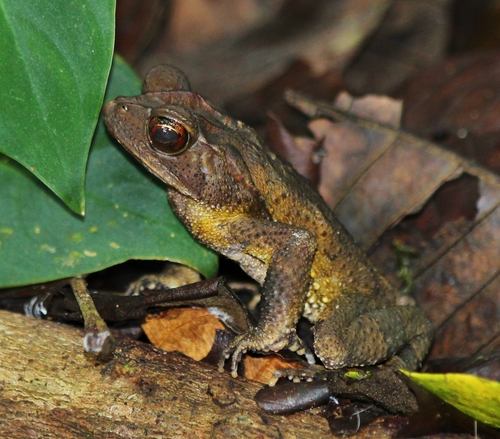
About Incilius leucomyos (McCranie & Wilson, 2000)
Adult Size
Description: For adult Incilius leucomyos, males measure 51–68 mm (2.0–2.7 in) in snout–vent length, while females measure 55–96 mm (2.2–3.8 in).
Body & Head Shape
The species has a robust body, and a head that is slightly wider than it is long. The snout is nearly rounded, but has a protruding tip when viewed from the dorsal direction.
Tympanum Features
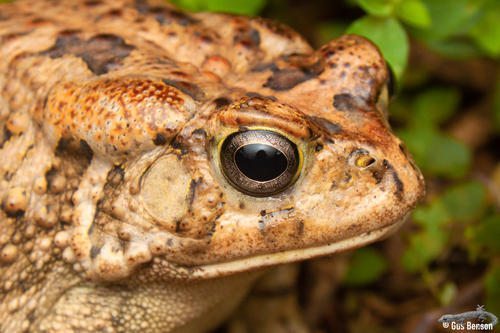
The tympanum is distinct, but comparatively small.
Cranial Crests
Canthal, supra-orbital, post-orbital, supra-tympanic, and parietal crests are all well-developed.
Parotoid Glands
Parotoid glands are sub-triangular.
Limbs & Digits
Limbs are relatively long. Fingers are long and slender, with no enlarged tips or webbing. Toes are also long and slender, but have partial webbing.
Skin Texture
The skin is rugose on the dorsal side, and granular to strongly granular on the ventral side.
Dorsal Coloration
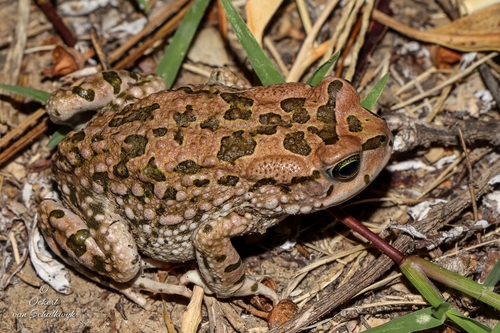
Dorsal coloration is mostly yellow ocher, with a buff-colored mid-dorsal area. There is a rust-brown inter-ocular bar, rust-colored crests, and pale rust-colored post-ocular blotches.
Natural Habitats
Habitat and conservation: The natural habitats of Incilius leucomyos are lowland moist forests, as well as premontane and lower montane wet forests.
Altitudinal Range
Its altitudinal range extends from near sea level to 1,600 m (5,200 ft) above sea level.
Tadpole Habitat
Tadpoles of this species develop in streams.
Conservation Threats
Incilius leucomyos is threatened by habitat loss caused by landslides that impact streams, alongside habitat loss from farming, logging, and human settlements.
Protected Area Occurrences
It is found in several protected areas, including La Muralla National Park and Pico Bonito National Park.