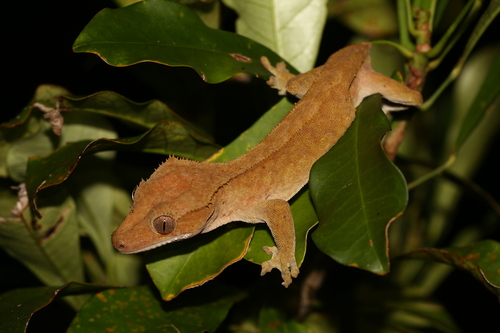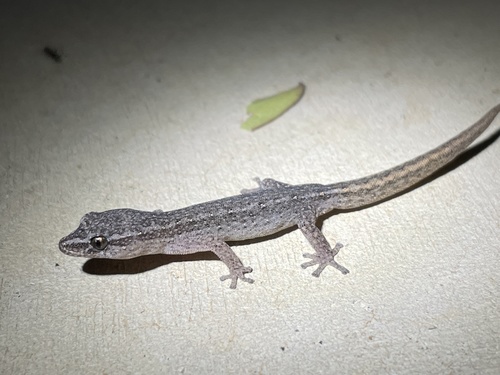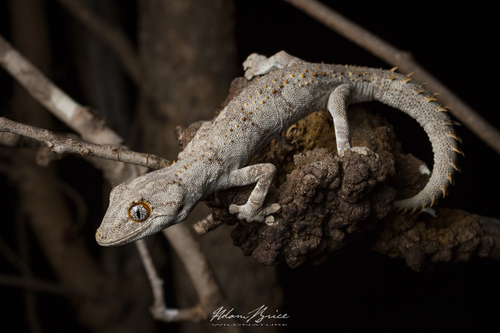
About Hoplodactylus duvaucelii (Duméril & Bibron, 1836)
Common Name and Endemicity
Hoplodactylus duvaucelii, commonly called Duvaucel's gecko, is the largest living gecko species native to New Zealand.
Size Measurements
Adults reach 160 millimeters in snout-to-vent length (SVL), with a total length of approximately 30 centimeters including the tail, and can weigh up to 120 grams.
Lifespan
Wild individuals have an estimated lifespan of 50 years, while captive individuals have a lower maximum lifespan of over 40 years.
Body and Limb Morphology
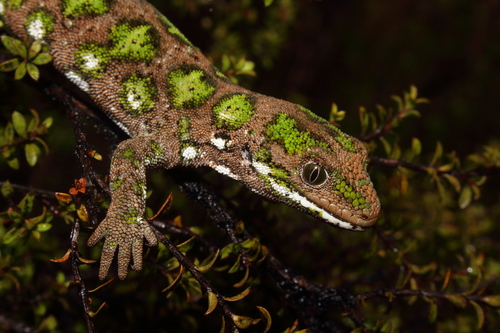
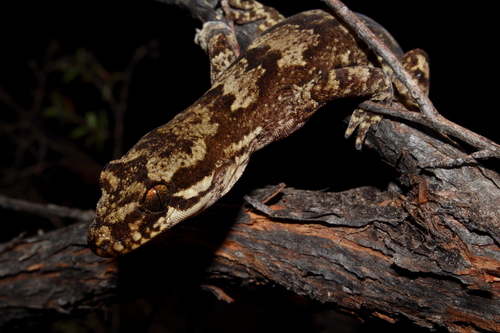
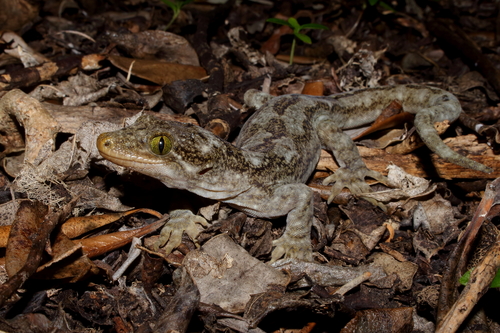
Duvaucel's gecko is a heavy-bodied lizard with a relatively large head and long toes that have expanded pads.
Base Coloration
Its base coloration is mostly grey, often with a faint olive-green tint.
Body Markings
Irregular blotches typically run sideways across the body from the back of the head to the base of the tail, and the body is never striped.
Foot Size Characteristics
Its front feet are smaller than its back feet, and foot area increases with snout-to-vent length for both front and back feet.
Historical Distribution
Subfossil and genetic evidence indicates that Duvaucel's gecko was once distributed across the entire New Zealand mainland.
Range Reduction Causes
After Polynesian and later European colonization of New Zealand, human-caused habitat loss and predation by the Polynesian rat kiore (Rattus exulans) restricted the species' range to predator-free or predator-controlled offshore island sites.
Current Distribution
Today, H. duvaucelii is mostly found on 11 New Zealand offshore island sites in the Cook Strait (including Mana Island and North Brother Island) and along the eastern coast of the North Island (including Great Barrier Island, Poor Knights Island, Motuora Island, and Tiritiri Matangi).
Subpopulation Size Variation
Population partitioning has been observed between these two island groups: individuals from Cook Strait island subpopulations grow larger than those from North Island subpopulations.
Translocation Efforts
Conservation efforts have expanded the species' range through population translocations.
2016 Mainland Reintroduction
In 2016, 80 individuals were reintroduced to the predator-free mainland site of Tawharanui Open Sanctuary on the Tawharanui Peninsula.
Captive Breeding Translocation
Individuals have also been translocated to Massey University's captive breeding program in Auckland.
Habitat Types
Duvaucel's gecko is a habitat generalist that occupies lowland forests, tussock vegetation, and coastal cliffs.
Predator-Induced Cryptic Behaviour
Range overlap with predator species on offshore islands, particularly tuatara (Sphenodon punctatus) and kiore, has caused behavioural changes in Duvaucel's gecko, most notably increased cryptic behaviour when these species are present.
Resource Competition with Tuatara
Tuatara are also nocturnal and share similar habitat and diet with Duvaucel's gecko, leading to resource competition and exclusion from nighttime foraging.
Temporal Avoidance of Tuatara
Duvaucel's gecko has adapted to this competitive pressure through temporal avoidance, foraging later into the night when tuatara are less active.
Site Fidelity and Aggressive Interactions
The species' high site fidelity increases the frequency of aggressive interactions with territorial tuatara.
Spatial Avoidance of Kiore
Predation pressure from kiore has led to microhabitat-scale spatial avoidance: Duvaucel's gecko shifts to more open spaces, occupies arboreal habitat higher in the forest strata, or is entirely excluded from forests to occupy shoreline and coastal cliff regions.
Niche Partitioning Benefits
These separate spatial and temporal ranges allow Duvaucel's gecko to reduce predation risk and competition from other species.
Predator Impact on Population Metrics
The presence of predatory species also negatively impacts population metrics.
Recruitment Limitation
High predation on inexperienced juvenile individuals limits recruitment, creating long-term conservation concerns for the species.
Monitoring Challenges
Increased cryptic behaviour makes population monitoring more difficult, as individuals are less active and use changing habitats.
Small Population Vulnerability
Small populations are especially vulnerable, as they have limited future recruitment potential and lower genetic variation.
Mating System
Duvaucel's gecko is likely a polygynandrous species.
Mating Season
Its mating season occurs between September and October.
Reproductive Mode and Gestation
The species is viviparous; after a 5 to 8 month gestation period, juveniles are born between February and May.
Sexual Maturity Age
Individuals reach sexual maturity at 7 years of age.
Female Reproductive Frequency
After reaching maturity, females produce juveniles either annually or biannually.
Litter Size
One juvenile is produced per reproductive cycle, though a maximum of two offspring has been recorded.
Reproductive Output Comparison
This gives the species a lower annual reproductive output compared to other New Zealand gecko species.
Parental Care
Parents provide very little care to juveniles, which are mostly independent immediately after birth, though maternal viviparity provides improved incubation conditions for developing offspring.
Reproductive Hormone Changes
Reproductive females experience hormonal changes during the pre-ovulatory period, with higher oestradiol and progesterone levels than nonreproductive females.
Courtship Sensory Behaviour
Courtship involves both physical and chemosensory behaviour from both sexes.
Male Courtship Initiation
Males initiate courtship by approaching the female and performing tongue flicks.
Male Pre-Copulatory Physical Contact
They then touch their snout to the female's head, dorsal surface, and cloacal area, before biting her body.
Female Courtship Response
Females typically respond defensively with tail flicks and thrashes, and may bite the male.
Courtship Grip
After this initial interaction, the male takes a courtship grip.
Receptive Female Behaviour
If the female is receptive, she stiffens her body into a courtship pose and stops displaying with her tail.
Non-Receptive Female Behaviour
If she is not receptive, she moves away from the male and seeks refuge.
Rejected Male Behaviour
Rejected males behave aggressively toward females, guarding the entrance to her refuge in an enlarged stance with an arched back and extended legs.
Mating Position
When mating begins, the male positions himself on top of the female, aligns his tail with hers, and inserts a hemipenis into her cloaca.
Copulation Duration and Post-Copulation Behaviour
Copulation lasts approximately 14 minutes, after which the hemipenis is withdrawn and both individuals separate to seek refuge.