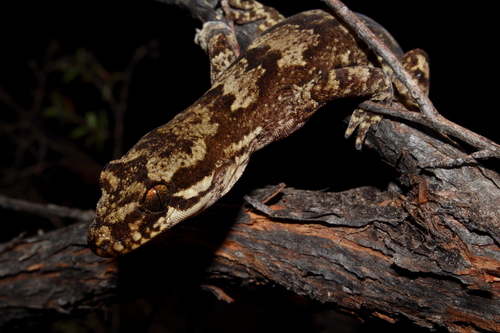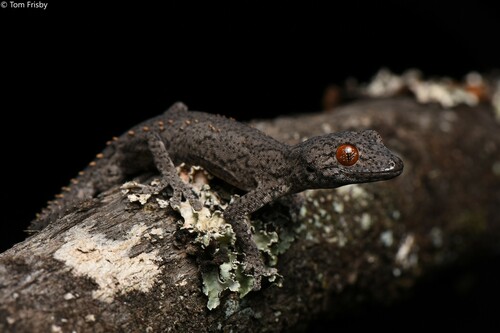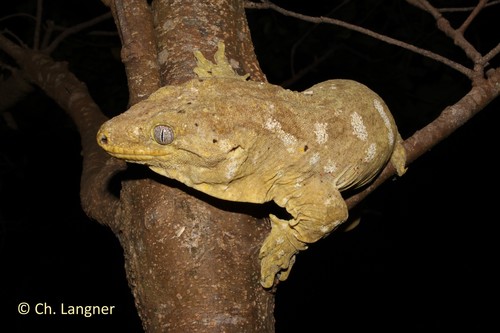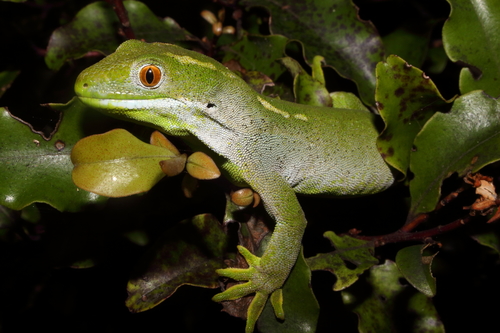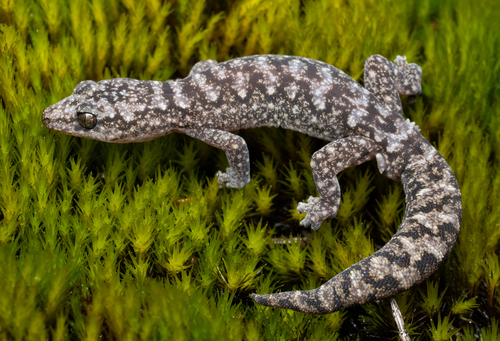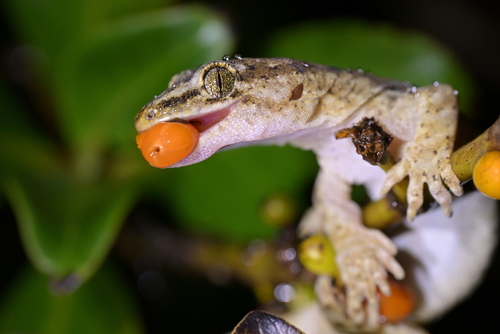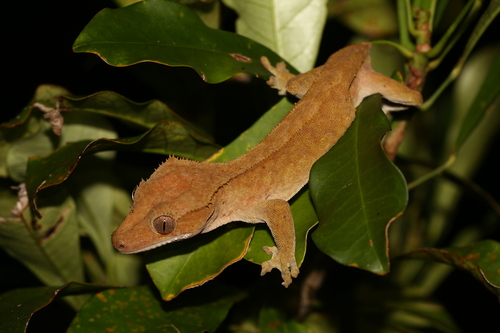
About Correlophus ciliatus Guichenot, 1866
Common Name & Size
Correlophus ciliatus, commonly called the crested gecko, usually measures 8–10 inches (20–25 cm) in total length, 4–6 inches (10–15 cm) of which is tail length.
Eyelash-Like Projections
One of its most distinctive features is a set of hair-like projections above the eyes that resemble eyelashes. These projections continue into two rows of spines that run from the eyes along the sides of its wedge-shaped head all the way to the base of the tail.
Eyelid and Eye Moistening
Crested geckos do not have eyelids. Instead, a transparent scale called a spectacle keeps each eye moist, and the gecko uses its tongue to clear debris from its eyes.
Pupil Structure and Vision
This species has Gehyra pupils, which are slit-shaped with lobed edges. It has large cones and apertures that give it a wide but short-sighted view, which helps with nocturnal hunting.
Semi-Prehensile Tail Use
The crested gecko has a semi-prehensile tail that it uses to assist with climbing.
Caudal Autotomy Process
The tail can be dropped through a process called caudal autotomy to distract predators; drop points are predetermined at specific segments where small fractures form in the tail bone.
Tail Regeneration Ability
Unlike some species, the crested gecko does not regenerate its tail after it is lost, and most wild adults do not have tails.
Blood Loss During Tail Drop
When the tail is dropped, the capillaries in the tail close almost immediately, resulting in almost no blood loss.
Dropped Tail Movement
The dropped tail continues to move for 2–5 minutes after separation.
Setae on Toes and Tail
The toes and the tip of the semi-prehensile tail are covered in small hairs called setae. Each seta is divided into hundreds of smaller hairs, called spatulae, that are approximately 200 nanometres in diameter.
Climbing Adhesion Mechanism
These structures are believed to use weak van der Waals force to help the gecko climb on most solid surfaces, climbing most easily on flatter, smoother surfaces like glass or wood. The toes also have small claws that help the gecko climb surfaces that its toes cannot cling to.
Natural Color Groups
The crested gecko has many natural color groups covering various shades of grey, brown, red, orange, and yellow.
Wild Color Morphs
In the wild, it occurs in three color morphs: pattern-less, white-fringed, and tiger.
Endemic Range
This species is endemic to South Province, New Caledonia.
Disjunct Populations
There are three separate disjunct populations: one on the Isle of Pines and its surrounding islets, and two on the main island of Grande Terre.
Grande Terre Population Locations
On Grande Terre, one population lives around the Blue River protected provincial park, and the other lives farther north, just south of Mount Dzumac.
Arboreal Habitat Preference
The crested gecko is a mostly arboreal species that prefers to live in the canopy of New Caledonia's rainforests.
Locomotion Between Branches
It can jump long distances between branches to move to new locations.
Activity Cycle and Resting Behavior
It is nocturnal, and generally spends daylight hours sleeping in secure spots on high branches.
Reproductive Behavior Data Source
Little is known about the crested gecko's reproductive behavior in the wild; most available information comes from observations of captive animals.
Egg Clutch and Incubation
Females generally lay two eggs per clutch, which hatch 60–150 days after being laid.
Post-Mating Clutch Production
A female only needs to mate once to produce clutches of two eggs every 4–6 weeks for a breeding cycle that lasts 8–10 months or longer.
Post-Breeding Cooling Cycle
After a breeding cycle, wild females go through a "cooling" cycle, usually triggered by slight changes in temperature and daylight during the winter season. During this cooling period, females regain the body mass and nutrients they lost while laying eggs.
Oral Calcium Sacs
The crested gecko has two small calcium sacs on the roof of its mouth.
Calcium Deficiency Risk
If an egg-laying female does not get enough calcium, her calcium sacs will be depleted, and she can develop calcium deficiency. This can lead to a condition called calcium crash, which causes the female to appear shaky or wobbly, become lethargic, lose her appetite, and can even result in death.
Calcium Sourcing
Calcium supplements are available for captive crested geckos, but it is unknown how wild individuals get enough calcium.
Hatchling Feeding Behavior
Newly hatched crested geckos generally do not eat until after they have shed and eaten their first skin; they rely on the remains of their yolk sack for nutrition until this point.