About Hippocampus kelloggi Jordan & Snyder, 1901
Common Name & Head Trait
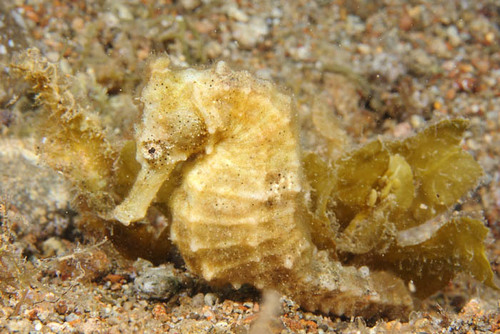
This species, commonly called the great seahorse, has a head that resembles a crown.
Spine Characteristics
Its spine is very noticeable, but has a rounded shape, especially the spine above its eye.
Identification Challenges
The great seahorse is often confused with other seahorse species, and some great seahorses have even been mistaken for an entirely new species, but genetic sequencing has disproven this idea.
Tail Features
Great seahorses can be distinguished by their abnormally high number of tail rings on their slightly longer tails, which make up approximately 57% of their total body length.
Body Color & Texture
They are pale in color and have a smooth texture.
Wild Lifespan
In the wild, great seahorses live between two and four years.
Indo-Pacific Distribution
Great seahorses are found in the Indo-Pacific region, with documented records ranging from the coast of East Africa to Japan.
Australian Presence
They have also recently been identified around both northern and southern Australia.
Coral Habitat Use
They are commonly found in areas with abundant coral, which they use to anchor themselves.
Depth Range
While they are often found in shallow waters, they have been recorded at depths of over 100 meters, and the deepest recorded great seahorse was found at 152 meters below the surface.
Male Brooding Trait
In great seahorse reproduction, males carry fertilized eggs in a brood pouch.
Gestation & Post-Birth Care
Gestation lasts a few weeks, after which males release the young and do not provide further care.
Male Breeding Readiness
Generally, males are ready to breed again almost immediately after giving birth.
Monogamy Research
Although little is known about the specific breeding habits of the great seahorse, studies of closely related seahorse species found that they are occasionally monogamous.
Mating Ritual
Their mating ritual involves twisting tails and nodding heads, until a pair bond is formed.
Mate Competition
Even though males carry the unborn young, they are also the main competitors for mates, which may be related to an uneven sex ratio in great seahorse populations.
Human Use Categories
Like many other seahorse species, the great seahorse is used both in traditional medicine and kept as an aquarium species.
Captive Care Challenges
It is one of the harder seahorse species to purchase and care for in captivity, because it is large and does not compete well with other fish for food, which often results in early death.
Traditional Medicine Demand
One of the main drivers of great seahorse removal from wild populations is demand for its use in traditional medicine in China and other East Asian countries.
Traditional Medicine Uses
It is claimed to help treat conditions such as impotence, and market demand for great seahorses has increased in recent years.
Souvenir Trade
Besides private aquariums and traditional medicine, great seahorses are also sold as souvenirs, often dried for personal purchase.
Conservation Status
The combination of these three uses has led the great seahorse to be classified as a vulnerable species.