About Hippocampus hippocampus (Linnaeus, 1758)
Maximum Length
Hippocampus hippocampus, the short-snouted seahorse, can grow up to 15 centimetres (5.9 in) long.
Head Features
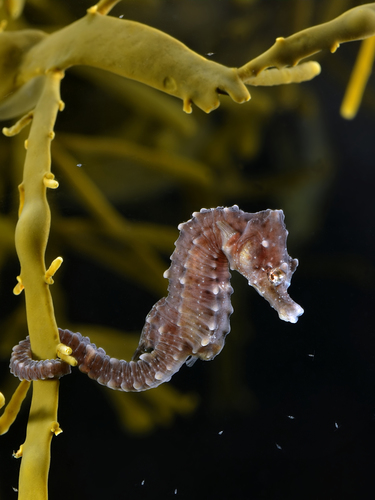
It has a prominent spine above each eye, and a short, upturned snout that makes up roughly one-third of the total head length.
Dorsal Fin Structure
Its dorsal fin has 16–18 rays with a dark stripe running parallel to the margin, and this fin provides propulsion.
Pectoral Fin Structure
The pectoral fins, which have 13–15 rays, sit below the gill openings and are mainly used for stability and steering.
Body Shape
The seahorse’s angular body shape comes from bony tubercles located along its body rings.
Body Coloration
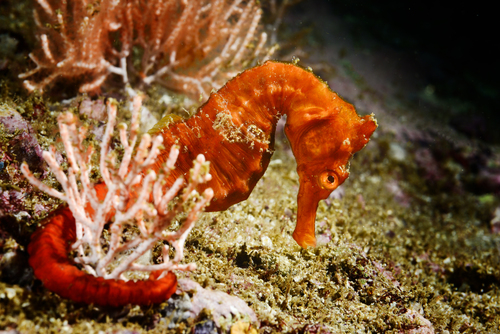
Body coloration can be black, purple, orange, or brown.
Tail Function
Its tail cannot bend backwards, but is semi-flexible; the seahorse uses it as an anchor by wrapping it around coral or seagrass, and also uses it to hold onto a partner during courtship and mating.
Habitat and Depth Range
Short-snouted seahorses typically live on rocky bottoms, in seaweed, or along the edges of seagrass beds in shallow muddy water, and are only found at depths up to 77 metres (253 ft).
Movement Patterns
They have a very restricted home range due to their limited daily movements; most of their movement happens during storms, when they are carried by currents or transported after grasping onto floating debris.
Winter Migration
In winter, they typically move into deeper water to avoid rough seas.
Camouflage Behavior
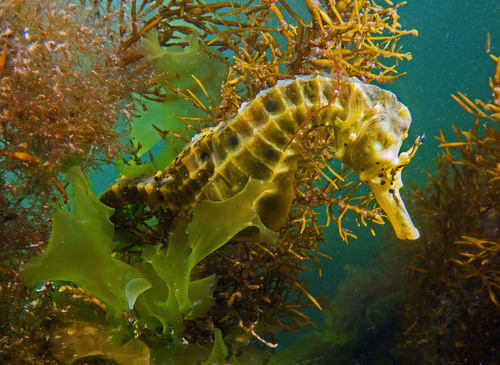
They anchor themselves to plant stems with their tails, and can camouflage very effectively.
Overall Distribution Range
This species is found in the northeastern Atlantic: it ranges from northwestern Scotland and the Netherlands south to Senegal, also occurs in the Mediterranean Sea, and is present in the coastal waters of the Azores, Madeira, and the Canary Islands.
Distribution in Britain and Ireland
In Britain and Ireland, its distribution is shaped by the warmer waters of the Gulf Stream, which support higher plankton productivity. As a result, both this species and the long-snouted seahorse are mainly found along southern and western coasts, but small populations of both also occur in the North Sea where the Gulf Stream flows into the sea north and south of Great Britain.
River Thames Discovery
In 2007, colonies of this seahorse were discovered in the River Thames around London and Southend-on-Sea.
Italian Coastal Distribution
A recent analysis has updated the distribution of H. hippocampus across Italy: the species is found along the entire Italian coast, with the largest populations concentrated in the seas around Sicily and Sardinia, as well as the Ionian and Tyrrhenian seas. A gap in suitable habitat exists along the northern Italian coast from Abruzzo to Emilia Romagna.
Italian Suitable Habitat Area
The Italian regions with the largest area of suitable habitat for H. hippocampus (over 1,500 km²) are Sicily, Sardinia, Apulia, Calabria, Tuscany, and Campania, while the regions with the smallest area of suitable habitat (less than 100 km²) are Molise, Emilia-Romagna, and Marche.
Reproductive Mode
Short-snouted seahorses are ovoviviparous: the female deposits eggs into a brood pouch located on the male’s abdomen, and the male carries out pregnancy and gives birth to live young.
Sexual Maturity Timeline
Sexual maturity is reached during the first reproductive season after birth, and the length of the reproductive season varies based on water temperature, light levels, and water turbulence.
Male Sexual Maturity Identification
In males, sexual maturity is identifiable by the presence of a brood pouch.
Male Aggressive Courtship Behaviors
Males exhibit two common, highly aggressive courtship behaviors toward competing males. The first is snapping, where a male aims and flicks his snout at a rival to push him away.
Snapping Behavior Outcome
If the attacking male succeeds, the rival will darken and flatten into a submissive posture to signal it has surrendered.
Wrestling Courtship Behavior
The second behavior is wrestling, which occurs when one male refuses to release his hold on a rival. Both males fall while their tails are interlocked, until the submissive male darkens and flattens into a surrender posture to be released.
Mating System
Mated pairs of short-snouted seahorses are monogamous, which is demonstrated through synchronized reproductive state changes and daily greeting interactions.
Pair Bond Maintenance
Pairs engage in daily greetings that last six to eight minutes, and their reproductive cycles align to maintain pair fidelity.
Pre-mating Signaling
When a male is ready to reproduce, he pumps water in and out of his brood pouch. Females signal readiness by pointing their head toward the water surface.
Egg Transfer Process
The female then aligns the base of her trunk with the opening of the male’s pouch and inserts her ovipositor into the pouch to deposit eggs, which are fertilized inside the brood pouch. This egg transfer only takes 6–10 seconds, and the male’s pouch closes after fertilization.
Egg Development Setup
The pear-shaped eggs implant into the pouch wall and become surrounded by specialized tissue. Capillaries deliver oxygen to the eggs, and placental fluid provides additional nutrients and oxygen while removing waste products.
Egg Nutrient Sources
The egg yolk from the female also supplies necessary nutrients. The male secretes the enzyme prolactin, which triggers the breakdown of the egg’s outer layer to allow placental fluid production.
Pregnancy and Labor
Pregnancy lasts 20–21 days, and labor typically occurs at night.
Offspring Production
A male produces between 50 and 100 young per pregnancy, and the number of offspring increases with the male’s age.
Post-birth Mating
If a male is paired with a familiar partner, he can mate again within a few hours of giving birth with no negative health effects.