About Hippocampus abdominalis Lesson, 1827
Body Structure
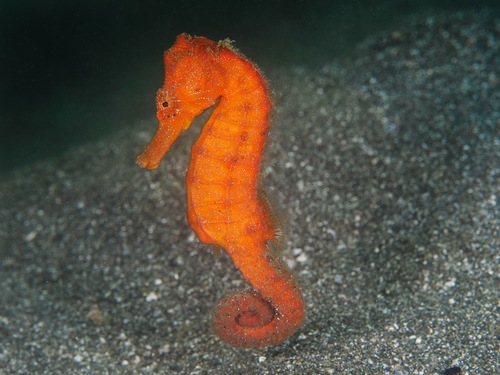
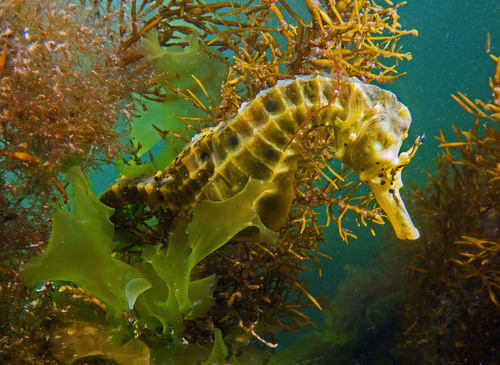
The big-belly seahorse (scientific name Hippocampus abdominalis Lesson, 1827) has a forward-tilted, long-snouted head, a distended but narrow pot belly, and a long coiled tail.
Coloration
Its colour can be yellow, brown, or sometimes white.
Swimming and Resting Behavior
It swims with a vertical stance using its dorsal fin; when not swimming, it coils its prehensile tail around suitable growth such as seaweed, and waits for planktonic animals to drift close enough to be sucked up by its small mouth located at the tip of the snout, in a motion similar to a vacuum cleaner.
Diet Composition
Big-belly seahorses are voracious feeders, that eat mainly crustaceans such as shrimp, and other small animals that live among seaweed, such as copepods and amphipods.
Feeding Physiology
They do not chew food, and can eat to excess because they have a small gut tract.
Visual Adaptation
Each of their eyes moves independently, which makes it easier for them to spot both food and predators.
Male Sexual Characteristics
It is easy to distinguish males from females: males have a smooth, soft pouch-like area at the base of the abdomen, on the front side where the stomach meets the tail. Males also have a fin in this area, but it is not obvious.
Female Sexual Characteristics
Females have a more pointed stomach, with a very obvious fin at its base.
General Distribution
Big-belly seahorses are found in the waters of Southeast Australia and New Zealand, and typically live in shallow environments such as large low-tide rock pools.
Predator Avoidance Behavior
They can stay motionless within seaweed, which helps them avoid predators.
Habitat Preference Rationale
These habitats are preferred because they are the most productive for the seahorse's ambush predation strategy.
Life Stage Habitat Differences
Juvenile big-belly seahorses are pelagic or attach themselves to drifting seaweed, while adults feed on minute crustaceans including copepods and amphipods.
Reproductive Mode
This species is nocturnal and ovoviviparous, with males carrying eggs in a brood pouch located under the tail.
Deeper Water Habitat Use
These seahorses are often seen in groups at night, and can attach themselves to sponges, colonial hydroids, or man-made structures such as jetty piles in deeper water.
Depth Range
They are typically found in water less than 50 m (160 ft) deep, though individuals have been observed at depths as great as 104 m (340 ft).
Species Distinguishing Traits
Notably, this is the largest seahorse species in southeastern Australia, and it has more dorsal fin rays and tail rings than any other seahorse species.
Vegetated Habitat Preference
When given a choice, both juvenile and adult big-belly seahorses prefer vegetated areas, even areas with artificial seagrass, over open water. They consistently choose vegetated areas even when mysid prey is present in adjacent open water.
Preference Rationale for Vegetation
This preference is tied to their predatory behaviour, as they rely on ambush predation.
Vegetation Density and Foraging Success
Vegetation density also affects the seahorses' foraging success. Increasing vegetation density from low to medium habitat complexity improves prey capture success for both juvenile and adult big-belly seahorses feeding on mysid swarms.
Juvenile vs Adult Foraging in Dense Vegetation
However, juvenile seahorses make fewer prey attacks in higher-density vegetation, while adult seahorses show no change in attack rate.
Prey Swarm Disruption Effect
The lower number of attacks in juveniles may happen because high vegetation density disrupts the structure of prey swarms, which normally form defensive formations. Large, cohesive prey swarms are more effective at defending against lunging predators, but dense vegetation breaks up this structure, making the prey more vulnerable to ambush predators like seahorses.
Substrate Preference Traits
Studies of substrate preference have found a strong preference for substrates with the largest diameter (0.9 mm) and the lowest density (24 mm bar length).
Substrate Attachment Behavior
Big-belly seahorses, which have prehensile tails, often attach to both natural and artificial substrates such as coral and aquaculture nets.
Early Juvenile Substrate Use
While early juveniles are pelagic during their first month of life, they already attach to substrates, which suggests they may prefer substrates with specific characteristics.
Aquaculture Substrate Implications
This matches earlier findings that highlight the need for appropriately sized substrates in seahorse rearing to promote optimal distribution and minimise stress.
Mating System Context
This species' complex use of space also relates to its mating system, suggesting that genetic monogamy in this species arises from factors beyond mate availability, and also involves intricate ecological and behavioural considerations.
Juvenile Density and Growth
Juvenile big-belly seahorses have optimal growth when held at lower densities. At higher densities, physical interference such as tail-grasping during feeding hinders growth and survival, and crowding negatively impacts juvenile development.
Gender and Growth Dynamics
Gender segregation does not significantly affect the growth of sexually mature seahorses, though same-sex courtship behaviours have been observed. This indicates that social dynamics among juveniles are more influenced by density than by gender.
Aquaculture Stocking Implications
This finding highlights the importance of managing stocking densities in aquaculture to support healthy growth and reduce competition during feeding.
Acute Stress Response
Big-belly seahorses do not show typical stress responses (such as changes in plasma cortisol, glucose, or lactate levels) after brief acute stress (60 seconds of air exposure), which indicates a lack of adrenergic activation.
Chronic Stress Response
Chronic stress (such as confinement or transportation) significantly raises stress marker levels, but these levels return to normal within six hours, demonstrating the species' capacity for recovery.
Stress Tolerance Implications
This rapid recovery suggests that big-belly seahorses tolerate handling and extended confinement (up to 35 hours) with minimal adverse effects, reflected in a low 1% mortality rate during recovery.
Opercular Beat Rate Response to Handling
Research analysing seahorse breathing patterns has found that both wild and captive big-belly seahorses show an increase in opercular beat rate (gill movements) after being handled. While wild seahorses have lower opercular beat rates at rest than captive seahorses, both groups show a significant increase after manipulation.
Captivity Acclimation Recommendations
This suggests that current captivity protocols should allow more than 24 hours of acclimation to ensure good recovery.
Breeding Age
In the wild, breeding starts when seahorses are around one year old; in captivity, this age can drop to around eight months.
Breeding Seasonality
Big-belly seahorses breed year-round, with breeding peaks in warmer months.
Courtship Initiation
Courtship begins with a series of colour changes and postural displays.
Male Courtship Pouch Display
The male slightly dilates the opening of his brood pouch, inflates the pouch to a balloon-like shape with water by swimming forwards or pushing his body forwards in a pumping action, then closes the pouch opening. At the same time, he lightens the colour of his pouch to white or pale yellow, and brightens his overall body colour, typically intensifying yellow tones.
Male Courtship Approach Behavior
The male repeatedly approaches his chosen female with his head tucked down, and rapidly flutters his dorsal and pectoral fins.
Non-Receptive Female Response
If the female is not receptive, she ignores the male, who will then look for another potential mate.
Unsuccessful Male Courtship Outcome
If no females are receptive, the male stops displaying and deflates his pouch by dilating the opening, bending forwards, and expelling the water inside.
Receptive Female Courtship Response
If a female is receptive to a courting male, she responds with her own colour changes and head tucking, typically intensifying lighter colours such as yellow and white to highlight the contrast between these lighter colours and her overall darker blotching and banding patterns.
Tandem Swimming Courtship Stage
Next, the pair performs a series of short bursts of tandem swimming, sometimes with their tails entwined, or with the female tightly rolling her tail up. This sequence is often described as 'dancing'.
Surface Approach Courtship Stage
After coming to rest, the male repeatedly points his snout upwards to attempt to lead the female to swim towards the water surface with him. If the female responds by also pointing her snout upwards, the final stage of courtship begins: both the male and female swim directly upwards toward the water surface, with their heads pointing up and tails pointing straight down.
Surface Courtship Behavior
When they reach the water surface, one or both seahorses can often be seen and heard snapping their heads.
Egg Transfer Process
To transfer her eggs to the male, the female faces the male, positioned slightly above him. She presses the base of her abdomen against the male's pouch, then squirts her eggs through the opening in the front of his dilated pouch.
Male Brooding Capacity
Male big-belly seahorses brood 300 to 700 young at a time, and can have up to four broods in a single summer.
Newly Hatched Juvenile Coloration
Newly brooded young have variable brown colouring, mottled with yellow-brown and marked with darker splotches. The tail often has yellow bands circling it.
Camouflage Coloration
In deeper water, where the tail anchors to other colourful organisms such as sponges and hydroids, big-belly seahorses often take on the colours of these anchor organisms.