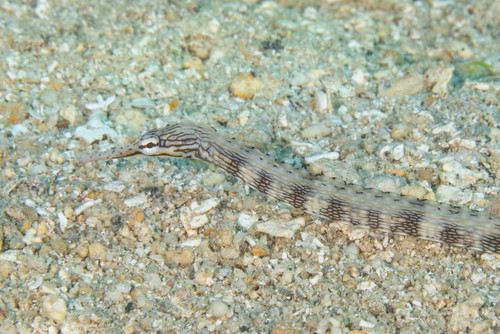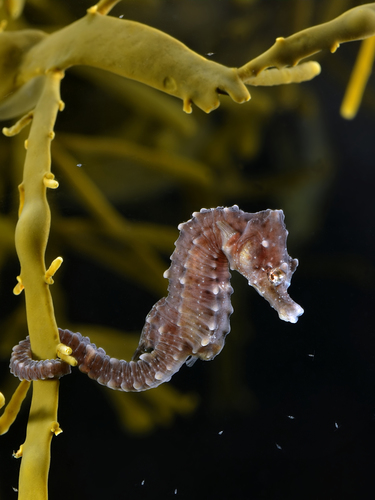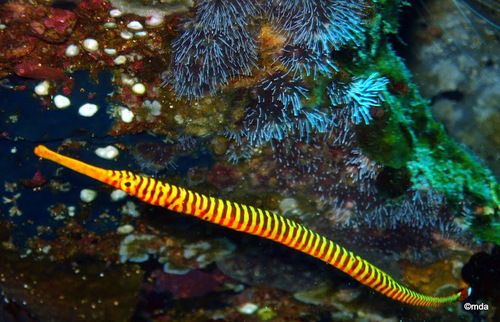
About Dunckerocampus pessuliferus Fowler, 1938
Nomenclature and Taxonomy
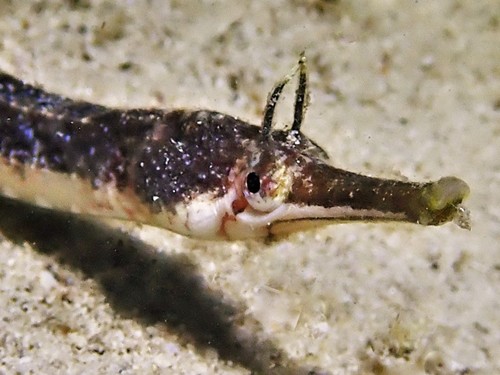
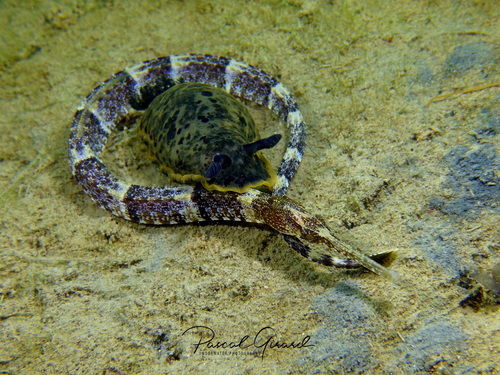
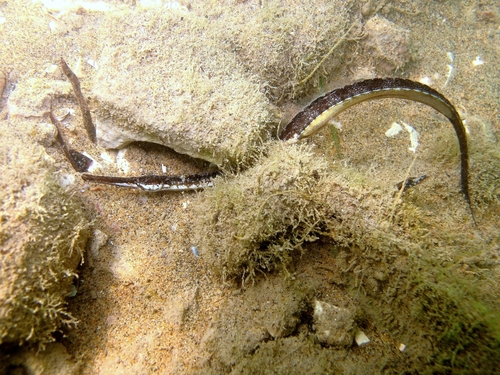
Dunckerocampus pessuliferus, commonly known as the yellowbanded pipefish, is sometimes also classified under the name Doryrhamphus pessuliferus. It is a species of marine fish that belongs to the family Syngnathidae.
Geographic Range
This is a coastal species that inhabits waters around the Coral Triangle, including the Philippines, Indonesia, and northwestern Australia.
Habitat and Depth Range
It lives in coral patches found on sandy and muddy slopes, at depths ranging from 15 to 44 metres, or 49 to 144 ft.
Size
Individuals of this species can grow up to 16 centimetres, or 6.3 inches, in length.
Diet
Yellowbanded pipefish are active cleaner fish that feed on parasitic crustaceans that grow on other fishes.
Adult Behavior
Adult fish of this species form pairs, and are most often observed swimming along the seafloor around large isolated coral heads on muddy slopes.
Reproduction
This species is ovoviviparous; males carry the eggs and give birth to live young.
Human Interactions and Conservation
Individuals of this species occasionally enter the aquarium trade, and the species is protected in Australia under the Environment Protection and Biodiversity Conservation Act 1999.