About Hippocampus bargibanti Whitley, 1970
Common and Scientific Name
This species, commonly known as Bargibant's pygmy seahorse, has the scientific name Hippocampus bargibanti Whitley, 1970.
Size
It is a tiny seahorse that measures less than one inch (2 cm) in length.
Host and Camouflage Effectiveness
It lives exclusively on gorgonian corals, and its natural camouflage is so effective that it is extremely difficult to spot among its host.
Discovery Delay
This camouflage even delayed the formal scientific discovery of the species: the species was only found when a host coral was being examined in a laboratory.
Initial Discovery Event
In 1969, New Caledonian scientist Georges Bargibant was collecting Muricella gorgonian specimens for the Nouméa museum, and he happened to spot a pair of these tiny seahorses on the coral while it was on his examination table.
Etymology
The following year, Whitley officially named the species Bargibant's pygmy seahorse in his honor.
Body Tubercles
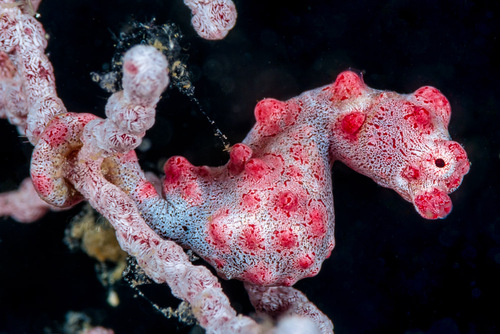
Large, bulbous tubercles, or knobs, cover the seahorse's body.
Camouflage Morphology
These tubercles match the color and shape of the polyps of its host gorgonian coral, while the seahorse's main body matches the color and shape of the gorgonian's stem.
Tail Use for Stability
The seahorse wraps its long prehensile tail around the gorgonian stem for stability.
Camouflage Function
This close matching of the seahorse's coloration and tubercles to its host Muricella gorgonian provides effective camouflage from predators.
Color Change Ability
It is currently unknown whether individual pygmy seahorses can change color if they move to a different sea fan, although other seahorse species such as Hippocampus whitei do have the ability to change color to match their surroundings.
Other Distinctive Morphology
Other distinctive characteristics of this pygmy seahorse include a fleshy head and body, a very short snout, and a long prehensile tail.
Distribution and Habitat Range
Bargibant's pygmy seahorse is distributed across coastal areas ranging from southern Japan and Indonesia to northern Australia and New Caledonia, where it lives on reefs and slopes at depths between 10 and 40 metres (33–131 ft).
Social Grouping
Adult Bargibant's pygmy seahorses are usually found in pairs or groups of pairs, and up to 28 individuals have been recorded on a single gorgonian coral.
Mating System
The species may be monogamous.
Male Brooding Trait
Like all other seahorses, male Bargibant's pygmy seahorses carry the species' developing young.
Breeding Period
Breeding occurs year-round.
Egg Laying Process
The female lays her eggs into a brood pouch located on the male's trunk region.
Egg Incubation
The male fertilizes the eggs, then incubates them until birth.
Gestation Length
Gestation averages two weeks.
Brood Pouch Trait
Among seahorse species, the brood pouch of male Bargibant's pygmy seahorse is unusually deep inside the body.
Birth Observation Record
One underwater observation recorded a male expelling a brood of 34 live young during birth.
Fry Appearance
The newly born young, or fry, look like miniature versions of adult seahorses.
Fry Characteristics Post-Birth
They are independent immediately after birth, receive no further parental care, and are dark in color.