About Hemidactylium scutatum (Temminck, 1838)
Ventral Coloration
The four-toed salamander, Hemidactylium scutatum, can be recognized by its white underbelly dotted with small black spots.
Dorsal and Flank Coloration
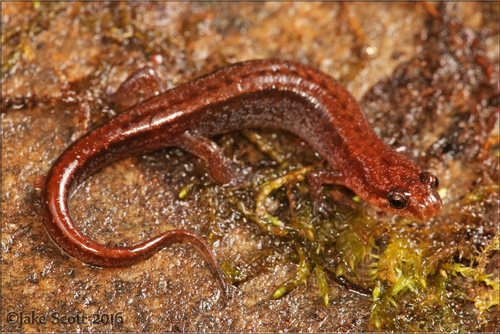
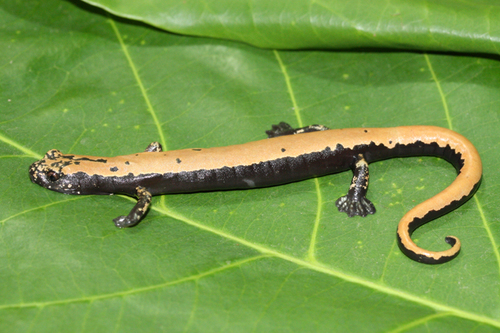
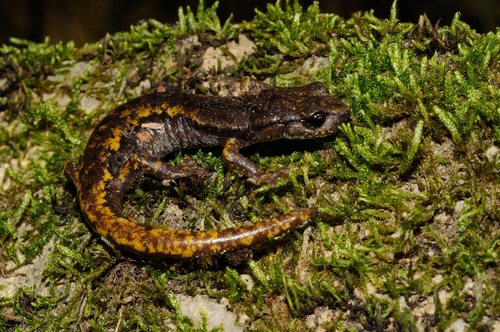
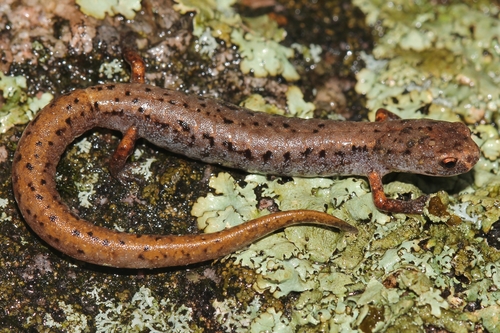
Its back ranges in color from orange-brown to red-brown, and its flanks are gray.
Body and Limb Morphology
This species has an elongated body and elongated limbs, a short snout, and prominent eyes.
Tail Morphology
The tail is typically a brighter color than the back, and a distinct constriction is visible at the junction where the tail meets the body.
Hind Limb Trait
As its common name suggests, its hind limbs have four toes, which is a useful identifying trait, though it can be difficult to observe in the field.
Total Length
The four-toed salamander rarely grows longer than 10 cm (3.9 in) in total length.
Breeding Season Sexual Dimorphism
During the breeding season, which runs from late October to early December, males develop enlarged premaxillary teeth and a blunt, squared snout; female snouts remain rounded.
Juvenile Tail Proportion
Juveniles have a tail that is shorter than their body.
Similar Species Confusion
In the wild, four-toed salamanders are easily confused with redback salamanders (Plethodon cinereus).
Distinguishing Features from Redback Salamanders
Redback salamanders have more extensive black markings on their underbelly, lack the constriction at the base of the tail that marks four-toed salamanders, and have five toes on their hind limbs, unlike the four-toed salamander.
Preferred Habitats
The preferred habitats of the four-toed salamander are sphagnum bogs, grassy areas surrounding beaver ponds, and moss-rich deciduous or mixed forests.
Seasonal Habitat Use
Four-toed salamanders use sphagnum bogs for reproduction, but occupy forest habitats during the summer.
Overwintering Habitat
They overwinter in terrestrial habitats below the frost line, using old burrows or cavities formed by rotting roots.
Overwintering Behavior
They often overwinter in groups, sometimes sharing overwintering sites with other amphibians including red-backed salamanders.
Canadian Distribution
In Canada, the four-toed salamander occurs in southern Ontario, southern Quebec, and Nova Scotia; a single population was recorded in New Brunswick in 1983.
United States Distribution
In the United States, it is found from Maine west to Minnesota, south to Alabama, and has also been recorded in eastern Kentucky.
Home Range Status
The home range size of this species has not been confirmed.
Habitat Proximity Research
It was previously thought that breeding, summer, and overwintering habitats all had to be located within 100 meters of each other, but recent observations indicate this distance is likely an underestimate.
Mating Period and Location
Mating takes place in terrestrial areas during autumn.
Nesting Behavior
In early spring, females lay their nests on land, along the banks of small ponds.
Larval Hatching
After an embryonic development period of 4 to 6 weeks, larvae hatch and move to the nearby pond.
Aquatic Larval Stage Duration
Compared to other species in the same family, four-toed salamanders have a relatively short aquatic larval stage, which lasts between 3 and 6 weeks.