About Desmognathus aeneus Brown & Bishop, 1947
Size and Basic Morphology
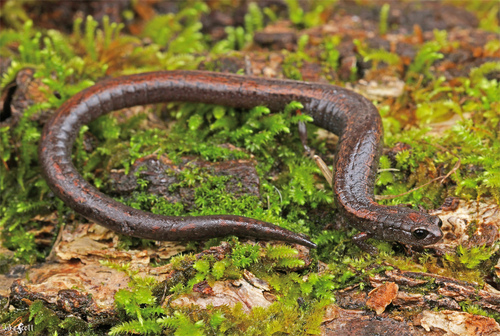
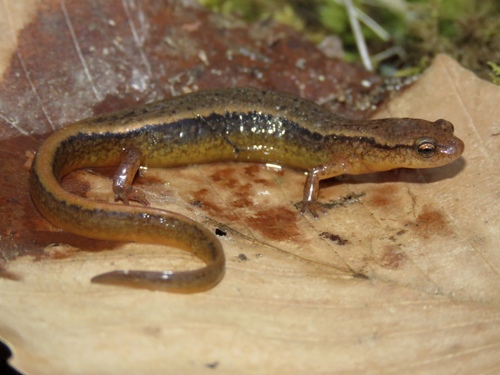
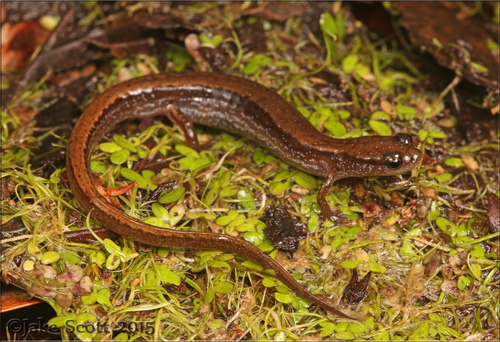
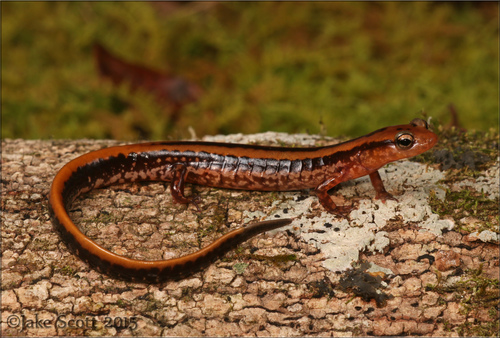
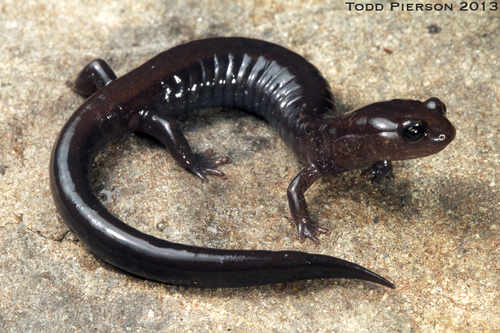
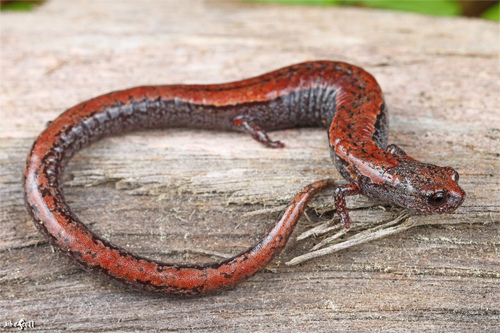
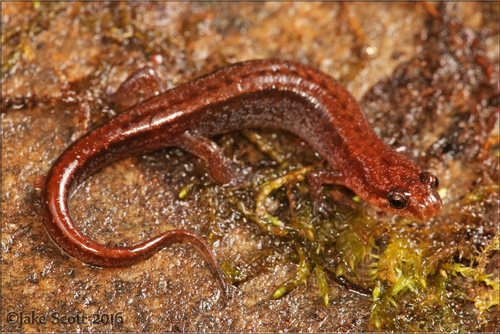
The seepage salamander (Desmognathus aeneus Brown & Bishop, 1947) is a very small, slender salamander that reaches a total length of 4.4–5.7 cm (1.75–2.25 in). Adult individuals have vomerine teeth, and their tails are terete and rounded.
Dorsal Stripe Characteristics
The species has a pale dorsal stripe that is wide, ranging from wavy to nearly straight in shape, and colored from yellow or tan to reddish brown. This stripe is sometimes flecked with darker pigment.
Dorsal Markings
A continuous dark mid-dorsal line runs from the back and connects to a Y-shaped mark on the head.
Lateral and Ventral Coloration
A dark brown band runs along the sides of the body, fading toward the belly. The underbelly is pale, and may be mottled with brown and white, or plain with no additional coloration.
Similar Species Overlap
The seepage salamander is easily confused with the pygmy salamander (Desmognathus wrighti), and the two species overlap in a small area of southern North Carolina.
Shared Genus Traits
D. wrighti and D. aeneus are the smallest species in the genus Desmognathus, and are the only terrestrial direct-developing species in the genus, meaning they lack a free-swimming larval stage.
Morphological Comparisons to Pygmy Salamander
Both species have vomerine teeth and similar ratios of tail length to total body length, but differ in pattern, coloration, and head morphology. Seepage salamanders have a smoother crown of the head, and male seepage salamanders have a differently shaped mental gland than male pygmy salamanders: pygmy salamanders have a large, U-shaped mental gland, while seepage salamanders have a small, kidney-shaped gland.
Taxonomic Classification
The seepage salamander belongs to the genus Desmognathus in the family Plethodontidae.
Plethodontid Family Traits
Like all plethodontids, it is lungless and breathes through its skin and the lining of its mouth. It also has a naso-labial groove and a relatively immovable lower jaw that helps it force its way under objects.
Desmognathus Genus Traits
Like all Desmognathus species, it has a pale diagonal line that runs from the eye to the angle of the jaw, which may be hard to see in older, darker adults. Its hind legs are larger and stouter than its forelegs.
Locomotion and Defense
It has a short, stout body and is a good jumper, a trait it often uses to escape threats.
Phylogenetic Position
Phylogenetic analysis shows that the seepage salamander branched early in the evolutionary history of the genus Desmognathus. D. aeneus forms a sister group to all Desmognathus species except D. wrighti, which is the outgroup to both.
Distinct Traits from Congeners
D. aeneus and D. wrighti have clear trait differences from all other Desmognathus species: they are the smallest, direct-developing, and the most terrestrial, while all other species in the genus are semi-aquatic or aquatic.
Evolutionary Inferences
Because these two species branched off earliest, researchers infer that evolution within Desmognathus has trended toward larger body size, longer larval periods, and more aquatic habitats.
Habitat Preferences
Seepage salamanders take their common name from the seepages where they are most often found, but they also occur near streams, and live under leaf litter, leaf mold, and rotten logs. They are a fully terrestrial species.
Geographic Range Overview
Their geographic range covers southeast Tennessee, southwest North Carolina, northern Georgia, and central to northern Alabama, with additional records from Oconee County, South Carolina.
Documented County Occurrences
Documented occurrence includes the Tennessee counties of Monroe and Polk; the Georgia counties of Fannin, Pickens, Towns, and Union; the North Carolina counties of Cherokee, Clay, Graham, Macon, and Swain; and the Alabama counties of Calhoun, Clay, Cleburne, and Tallapoosa.
Unconfirmed and Extirpated Populations
The species may also occur in the Alabama counties of Cherokee, Chilton, Etowah, Hale, and Tuscaloosa, but it may already be extirpated from these areas.
Distribution Pattern
Seepage salamander populations have a disjunct distribution and are highly localized. There is an isolated colony in western Alabama and another in northeastern Georgia.
Elevation Range
Most populations occur at elevations between 210–1,370 m (700–4,500 ft), though the northeastern Georgia colony occurs as low as 30 m (100 ft).
Interspecific Competition
Seepage salamanders face little competition from other salamander species due to their terrestrial habitat, which is not used by the semi-aquatic and aquatic salamanders that make up most other Desmognathus species, which stay closer to streams.
Secretive Behavior
Their low encounter rate may also be due to their secretive behavior: they are rarely seen on the surface, which may act as an anti-predator adaptation.
Niche Overlap with Pygmy Salamander
The only other Desmognathus species that shares the seepage salamander's habitat and could create competitive pressure is the pygmy salamander (D. wrighti), but the ranges of the two species rarely overlap.
Elevational Separation
Pygmy salamanders occur at higher elevations along the border of North Carolina and Tennessee, while the seepage salamander's range begins just below the pygmy salamander's elevation range.
Co-occurrence Records
Despite this separation, the two species have been found co-occurring in Monroe County, Tennessee, and may co-occur in Blount County, Tennessee.
Research Need
Further study of their interactions is needed to support conservation efforts.