About Trogon viridis Linnaeus, 1766
Size
This relatively large trogon measures 28 to 30 centimetres (11 to 12 inches) in length.
Sexual Dimorphism
Like most trogons, it shows strong sexual dimorphism.
Male Plumage - Head and Torso
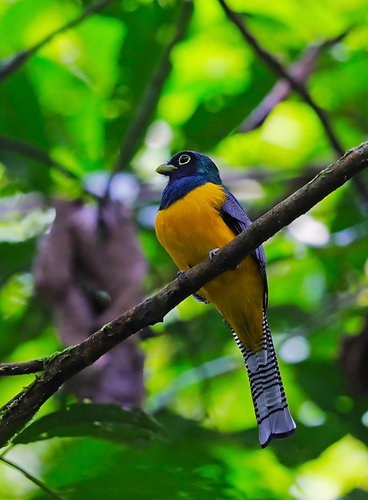
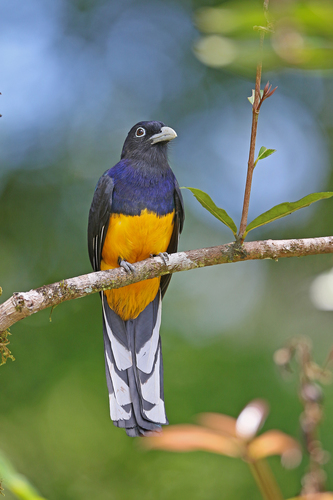
Males have dark blue head and upper breast (appearing blackish in poor light), a green back, and orange-yellow lower underparts.
Male Wing Pattern
Their wings are black with white vermiculation.
Male Undertail Pattern
The undertail is patterned black and white: each feather has a broad black base, and a broad white tip and outer edge.
Male Facial Feature
Males also have a complete pale bluish eye-ring.
Female Plumage
Females of this species resemble males, but have a grey back, head, and breast, and distinct black-and-white barring that is mainly found on the outer webs of each tail feather.
Similar Species Distinction - Violaceous Trogon
The similar smaller violaceous trogon can be distinguished from this species: male violaceous trogons have a yellow eye-ring, while female violaceous trogons have an incomplete white eye-ring, and male violaceous trogons also have barring on the undertail.
Similar Species Distinction - White-tailed Trogon
Green-backed trogons and white-tailed trogons have no overlapping distribution, but can be separated by their undertail pattern.
Unlike the green-backed trogon, male white-tailed trogons only have a very narrow black base to each feather, making the undertail appear almost entirely white, while female white-tailed trogons have black-and-white barring mainly on the inner webs of each feather, which can be difficult to see.
Male white-tailed trogons also have a bluer rump than green-backed trogons.
Vocalization - Song Characteristics
The song of the green-backed trogon is made up of around 20 "cow" notes that start slow and accelerate toward the end.
The song is slower than that of the white-tailed trogon, and higher pitched than that of the black-tailed trogon.
Geographic Range
The green-backed trogon occurs in tropical humid forests of South America; its range covers the Amazon basin, the Guiana Shield, Trinidad, and the Atlantic Forest in eastern Brazil.
Habitat Prevalence
It is a resident species of humid tropical forests, and is typically the most common trogon throughout its range.
Perching Behavior
Green-backed trogons typically perch upright and remain motionless.
Flight Behavior
Although their flight is fast, they are reluctant to fly long distances.
Morphological Adaptations
Their broad bills and weak legs reflect their diet and arboreal habits.
Diet - Primary Food Sources
They feed mainly on small fruit, and supplement their diet with arthropods and lizards.
Seasonal Diet Variation
They consume more arthropods and lizards in the dry season when fruit is scarce, but even during the dry season they remain among the most frugivorous trogons in their range.
Mixed-species Flock Occurrence
Because of their frugivorous diet, they are seen less often at mixed-species feeding flocks than other trogons.
Nest Site
This species nests in termite nests or cavities in rotten trees.
Nest Construction
If not always, the nest is usually built by the female, who excavates an upward-sloping tunnel that ends in a breeding chamber.
Nesting Season
The nesting season is apparently mainly during the summer months between June and August.
Clutch Size
A typical clutch has two or three white eggs.
Reproduction Timeline
Incubation lasts 16 to 17 days, and chicks fledge two weeks after hatching.