About Hakea lorea (R.Br.) R.Br.
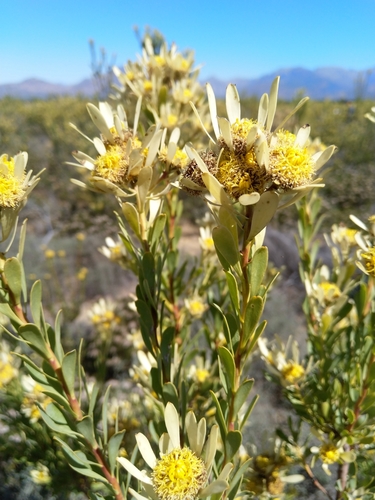
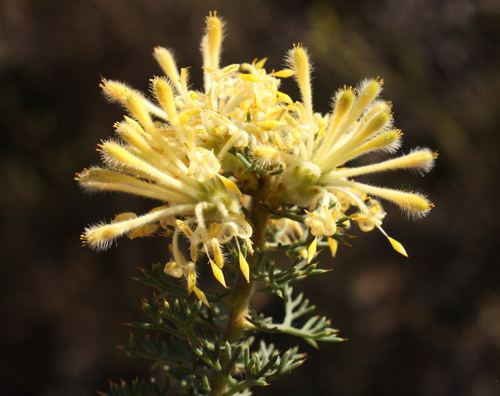
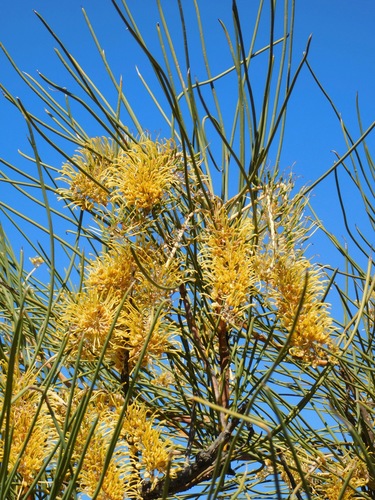
Hakea lorea (R.Br.) R.Br. grows as either a gnarled tree up to 10 metres (33 ft) tall, or a 1 to 5 m (3 to 16 ft) high shrub, and forms a lignotuber. Its branchlets and leaves are thickly covered in either flattened, soft silky hairs, or short, soft, matted woolly hairs. These hairs mostly persist over time, but branchlets eventually become smooth. The trunk has thick, cork-like bark marked with many furrows. The leaves are needle-shaped, either single or forked, and measure 15 to 70 centimetres (6 to 28 in) long and 1 to 2.5 millimetres (0.039 to 0.098 in) wide; they may grow upright or droop. The inflorescence holds 15 to 200 individual small flowers, which can be yellow, white, or green. Flowering occurs mostly from April to September. The inflorescence rachis is usually 50–250 mm (2.0–9.8 in) long, and is thickly covered in short, soft, silky hairs. The perianth is 5–12 mm (0.20–0.47 in) long, and the pistil is 15–33 mm (0.59–1.30 in) long; both structures are covered in short, soft hairs. The fruit are 2.5–5.4 cm (0.98–2.13 in) long and 0.9–2.8 cm (0.35–1.10 in) wide, with a long, curved, tapering beak. This species, commonly called cork tree, is distributed across the interior of central and northern Australia. Its range extends from southern Cape York Peninsula in the northeast, south to the Darling Downs in the southeast, and west to northern South Australia and the Pilbara. In cultivation, it is a slow-growing but attractive plant valued for its leaves and bark. Full sun and good drainage support healthy growth of this species.