About Petrophile biloba R.Br.
Taxon Name and Growth Form
Petrophile biloba R.Br. is a shrub that typically grows between 1 and 2 metres (3 ft 3 in to 6 ft 7 in) in height.
Branchlet Characteristics
It produces hairy branchlets that become hairless (glabrous) as they age.
Leaf Dimensions
Its leaves are 15 to 20 millimetres (0.59 to 0.79 in) long, borne on a petiole up to 20 millimetres (0.79 in) long.
Leaf Structure
The leaves are pinnately divided all the way to the midrib, with two or three lobes, each ending in a sharp point.
Flower Head Arrangement
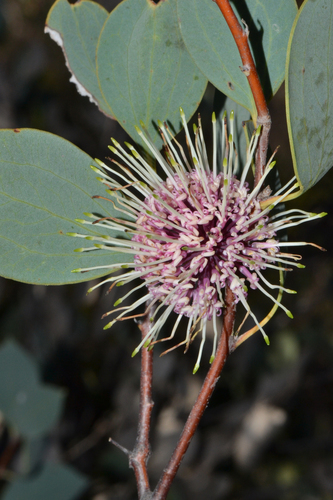
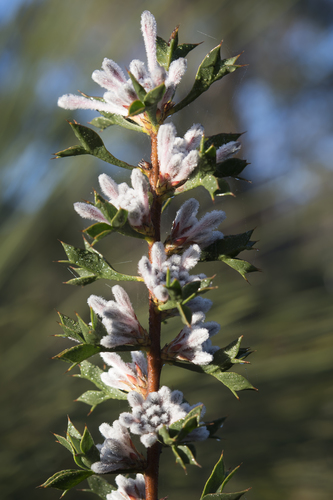
Flowers are arranged in leaf axils, forming sessile, oval-shaped flower heads around 15 millimetres (0.59 in) long, and these heads sometimes grow in clusters.
Involucral Bracts
A small number of deciduous involucral bracts are present at the base of each head.
Individual Flower Features
Individual flowers are around 17 to 25 millimetres (0.67 to 0.98 in) long, most often grey to pink in colour, and covered in hairs.
Flowering Period
Flowering takes place from June to October.
Fruit Structure
After flowering, the fruit is a nut that fuses with other nuts to form an oval head 10 to 14 millimetres (0.39 to 0.55 in) long.
Habitat
This species of petrophile grows in heath growing over laterite soil.
Distribution Range
Its distribution ranges from near the Canning River to near Wannamal, within the Jarrah Forest and Swan Coastal Plain biogeographical regions of southwestern Western Australia.