About Grevillea alpina Lindl.
Taxon Naming and Variability
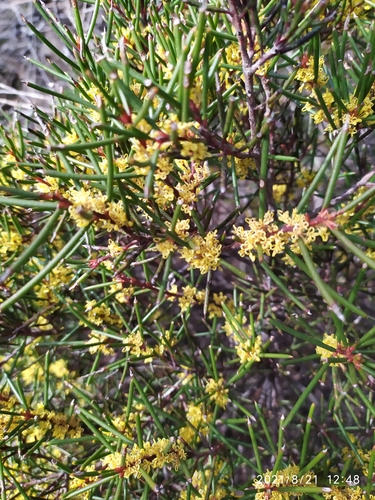
Grevillea alpina Lindl. displays considerable variation across its form, leaves, and flowers.
Mature Size
Mature plants reach between 0.3 and 2 metres (0.98 and 6.56 ft) in height.
Leaf Shape and Dimensions
Leaves can be linear, oblong, or elliptic, typically measuring 0.5 to 2 centimetres (0.20 and 0.79 in) long and 1.5 to 4 millimetres (0.059 to 0.157 in) wide.
Leaf Surface and Edges
Hairs may be present or absent on both leaf surfaces, and leaf edges are often curved backwards or revolute.
Perianth Base Color
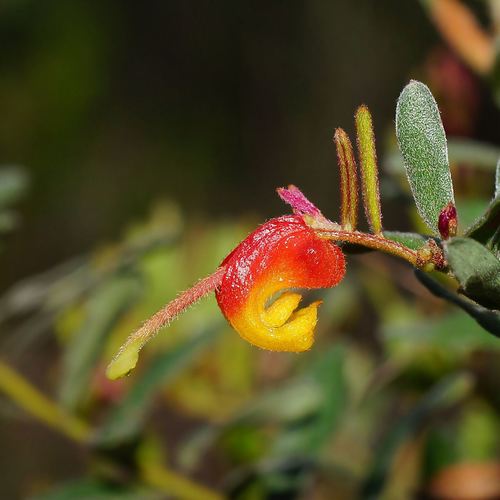
Flower colour is one of the species' most variable traits: the main colour of the perianth is most commonly red, orange, or pink, and more rarely yellow or cream.
Perianth Color Gradients
Colour often transitions along the length of the perianth, resulting in common red-yellow or red-cream combinations.
Native Flowering Period
In the species' native range, flowering occurs primarily from August to December.
Fruit Characteristics
After flowering, plants produce hairy, leathery, ovoid fruit called follicles that are 8.5 to 12 millimetres (0.33 to 0.47 in) long.
Seed Dispersal
These follicles split open to release winged seeds.
Eastern Distribution Range
Grevillea alpina is widespread in Victoria, Australia, extending north from Melbourne into New South Wales through Albury, and reaches as far north as Canberra, where it grows on Black Mountain.
Western Distribution Limit
Its westernmost native occurrence is in the Grampians, Victoria.
Native Habitat Types
It grows naturally in woodland, heathland, and mallee habitats.
Informal Form Classification
In their 1995 work The Grevillea Book, authors Peter Olde and Neil Marriott identified five informal forms of the species: the Grampians form; the type form with bright orange and yellow flowers; the Southern Hills form, found in areas surrounding Melbourne including Lerderderg Gorge, Kinglake, Mount Slide, Mount Evelyn, the Dandenong Ranges, and Cardinia; the Goldfields form, which occurs in Castlemaine, Bendigo, and Whroo Forest; the Northern Victorian form, found in areas including the Strathbogie Ranges and the Warby Ranges; and the small-flowered form, found in Beechworth, Chiltern, Albury, and Canberra.
Tooborac Population Status
Plants from Tooborac were originally classified as the small-flowered form, but the authors now believe they may represent a separate informal form.
Australian Native Hybrids
Naturally occurring hybrids between G. alpina and G. lavandulacea, G. dryophylla, and G. obtecta have been recorded.
New Zealand Naturalised Hybrids
In New Zealand, hybrids between G. alpina and Grevillea rosmarinifolia have become naturalised.
Primary Pollinators
Ecologically, honeyeaters are thought to be the major pollinators of G. alpina.
Honey Bee Nectar Feeding
Honey bees have been observed feeding on the species' nectar, but can do so without touching the pollen presenter.
Early Cultivation History
This species was first introduced to cultivation in England in 1856, and was in cultivation at the Royal Botanic Gardens, Melbourne by 1858.
Cultivation Lifespan
Though widely grown, it has a reputation for being short-lived.
Grafting Solution for Lifespan
This issue is more severe in humid climates with summer rainfall, and can be resolved by grafting G. alpina onto various rootstocks.
Preferred Cultivation Environment
G. alpina grows best in dry environments and does not tolerate excess moisture well.
Pruning Recommendations
Regular pruning starting from a young age encourages denser growth and reduces excess woodiness.
Seed Propagation Notes
Plants can be readily propagated from pre-treated seed, though seed collected from garden-grown plants often produces hybrid offspring.
Garden Hybridisation Tendency
The species hybridises readily with Grevillea rosmarinifolia, Grevillea juniperina, and Grevillea lavandulacea.
Cutting Propagation Use
Propagation from cuttings is the preferred method to preserve the traits of specific forms and cultivars.
Fungal Disease Susceptibility
In 2003, the fungal disease Phytophthora palmivora was detected in plant nurseries in Sicily, causing root rot and death in potted Grevillea cultivars; Grevillea alpina plants were the most severely affected among these cultivars.