About Hakea decurrens R.Br.
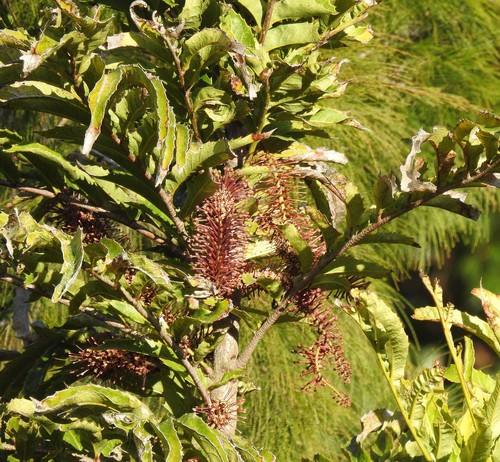
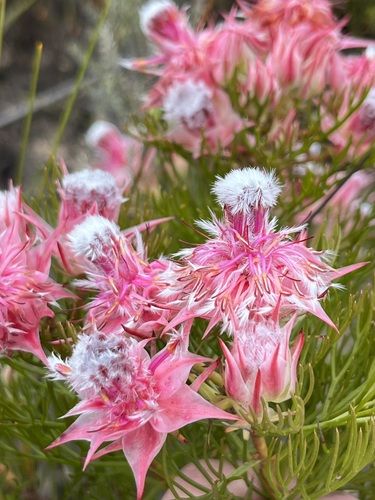
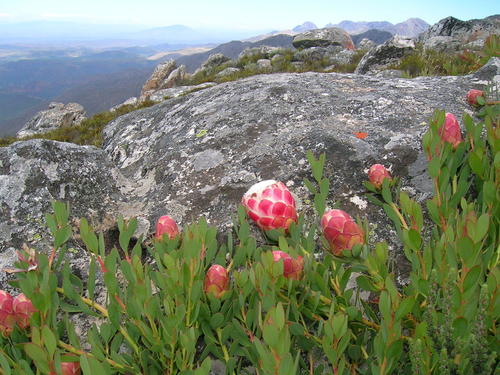
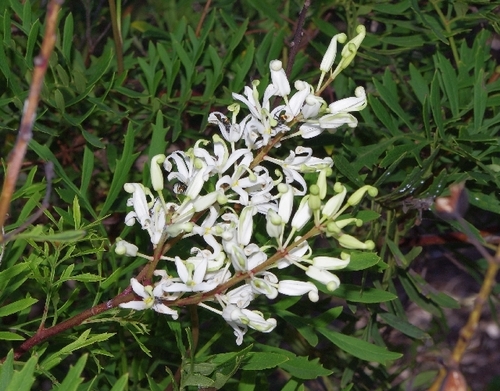
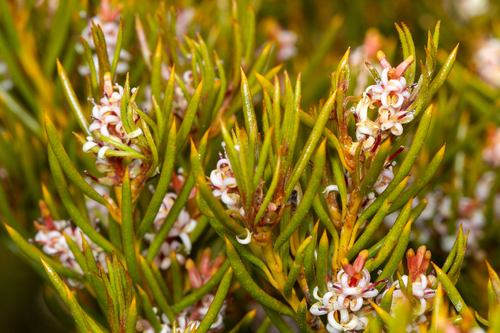
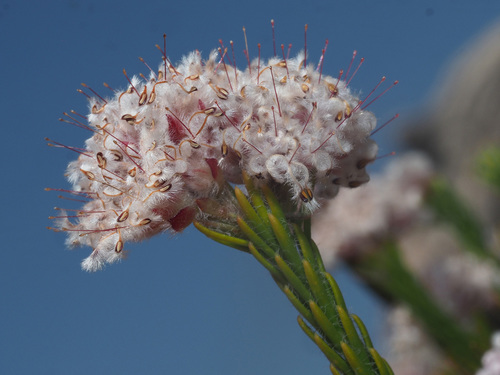
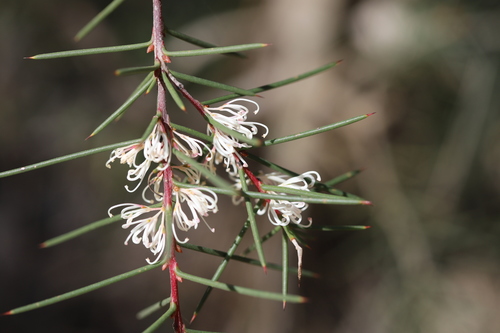
Hakea decurrens R.Br. is a plant that grows as a semi-prostrate to erect scrambling bush or small tree, reaching 0.4–5 m (1–20 ft) in height. Its smaller branches are covered in short, densely matted silky hairs, and some branches occasionally become hairless quickly. The leaves are needle-shaped, spreading widely horizontally, and measure 1.5–8 cm (0.6–3 in) long and 0.7–1.6 mm (0.03–0.06 in) wide. The smooth leaves are grooved on the underside, and end in a sharp point 1–3.5 mm (0.04–0.1 in) long. The inflorescence holds 1–6 white or pink flowers, borne on a short stalk that is white or rust-colored, and covered in either slight hair or dense matted hair. These hairs extend onto the pedicel, which is 1.2–4.8 mm (0.047–0.19 in) long. The smooth perianth is 4.2–7.2 mm (0.17–0.28 in) long, and the style is 8.5–12.2 mm (0.33–0.48 in) long. A profusion of flowers appears in leaf axils between May and September. The fruits are grey and woody, broadly egg-shaped, 1.8–3.5 cm (0.7–1 in) long and 1–3 cm (0.39–1.2 in) wide. They are covered in distinct warts, end in a prominent beak, and have two small horns. This species is native and widespread in the Australian states of New South Wales, Victoria, and Tasmania. It is additionally naturalised in South Australia and Portugal. Three subspecies have distinct distributions: H. decurrens subsp. decurrens occurs on the western slopes and plains of the Great Dividing Range in New South Wales; H. decurrens subsp. platytaenia occurs in exposed coastal heaths in southeastern New South Wales, eastern Victoria, and the Bass Strait Islands; H. decurrens subsp. physocarpa occurs in New South Wales, Victoria, and the Bass Strait Islands. In Tasmania, Hakea decurrens is thought to be native to the north of the state and naturalised in the south. It is also naturalised in the Mount Lofty Ranges of South Australia and in Portugal.