About Orites acicularis (R.Br.) Roem. & Schult.
Taxonomic Nomenclature
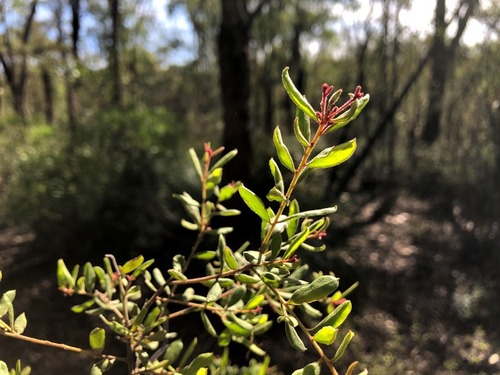
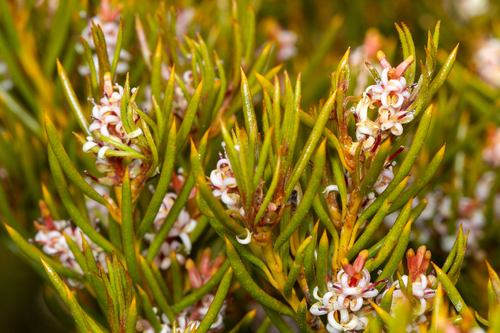
Orites acicularis (R.Br.) Roem. & Schult. is a yellow-green, woody, rounded shrub that reaches around 1–1.5 m in height and 0.5–1 m in width, with many ascending branches.
General Leaf Characteristics
Its leaves are noticeably yellow-green, glabrous, and sclerophyllous, measuring roughly 10–35 mm long. They have a rounded shape that tapers to a sharp point, which is typically more yellow than the rest of the leaf.
Leaf Surface and Margins
The upper (adaxial) surface of the leaf has a shallow central groove, and leaf margins are entire. Leaves connect to the woody stem via a 2–5 mm long petiole.
Flowering Period and Inflorescence
Flowering takes place in December, occurring on a rachis that can be either terminal or axillary.
Perianth Morphology
The perianth is homochlamydeous, made up of four white-cream tepals with a groove running along their center; the tepals curl under to reveal the pink style.
Immature Fruit Characteristics
Immature fruit is a similar shade of green to the plant’s leaves. Fruits are glabrous and oblong, with an elongated reddish brown tip.
Mature Fruit Morphology
When mature, the follicle is lignified, erect, approximately 15 mm long, and boat-shaped; this shape forms because seeds are released immediately after the fruit reaches maturity.
Species Habitat Range
This species commonly grows on Tasmanian sub-alpine mountain plateaus, in heaths, and in boulder fields over the rock types dolerite, granite, and diorite.
Dolerite Soil Properties
Dolerite erodes slowly, producing shallow, low-nutrient soils that contain many rock fragments.
Boulder Field Soil Formation
Depressions that form in boulder fields on sub-alpine plateaus accumulate organic and mineral matter, creating bogs or small patches of deep soil. Likewise, bolster heath slows drainage, forming shallow peats.
Associated Plant Species
Plant species that commonly grow alongside Orites acicularis in this habitat are Gleichenia alpina, Astelia alpina, Baeckea gunniana, Bauera rubioides, Orites revoluta, Richea sprengelioides, Tasmannia lanceolata, and Eucalyptus coccifera.