About Hicksbeachia pinnatifolia F.Muell.
Hicksbeachia pinnatifolia F.Muell. is a tree that grows up to 10 m (33 ft) tall, with a maximum trunk diameter of 20 cm (8 in). It can produce extra stems from its base and grows suckers after it has been cleared.
Leaf Characteristics
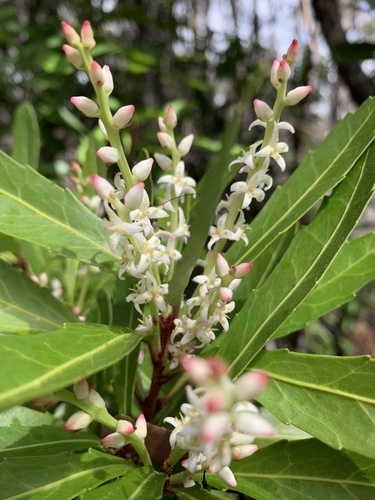
Its large compound leaves are pinnate, ranging from 40 to 100 cm (16 to 39 in) in length. Each leaf bears 15 to 25 individual leaflets, which measure roughly 6–25 cm (2+1⁄2–10 in) long and 2–6 cm (3⁄4–2+1⁄4 in) wide. The edges of the leaves have fine teeth.
Flower Features
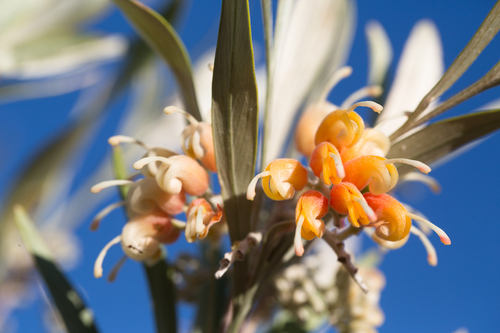
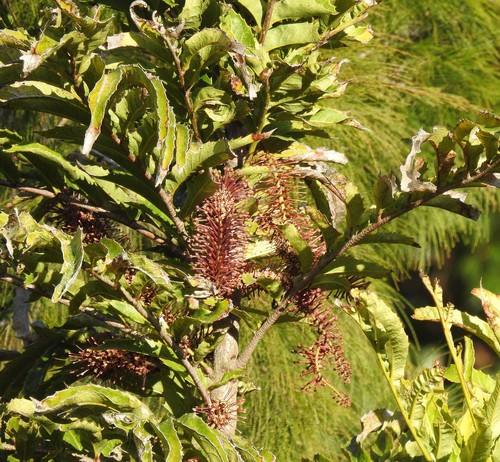
Both new growth and the inflorescences that appear from winter to spring (August to October) are covered in fine rust-colored hair. The drooping flower spikes are 14 to 50 cm (5+1⁄2 to 19+1⁄2 in) long, and come in shades of purple, brown, and cream. The flowers have a strong sweet scent that some people describe as sickly.
Fruit Attributes
After flowering, the tree produces red, fleshy, oval fruit in spring and summer. The fruit measures 3–5 cm (1+1⁄4–2 in) long and 2–2.8 cm (3⁄4–1 in) wide, and contains a black seed that does not detach from the fruit.
Habitat Range
Hicksbeachia pinnatifolia grows in and on the margins of subtropical rain forest, ranging from Tamborine Mountain in the southeastern corner of Queensland to the Nambucca Valley on the mid-north coast of New South Wales. It grows as part of the rain forest understory.
Edible Seed
The seed of Hicksbeachia pinnatifolia is edible, though it is not as valued as the seed of its relative the macadamia.
Cultivation Notes
The species is not commercially cultivated, but it is sometimes grown as an ornamental tree. It can be difficult to establish in garden settings. Germination from fresh seed is reliable, with a high success rate, but many young seedlings quickly die from fungal disease. Alexander Floyd recommends adding leaf litter collected from beneath the parent tree to the planting site to encourage beneficial anti-fungal micro-organisms.