About Grevillea synaphea subsp. synaphea
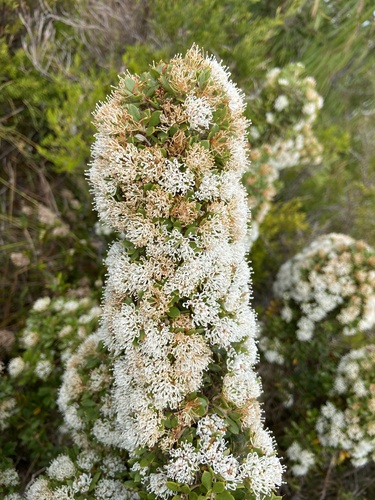
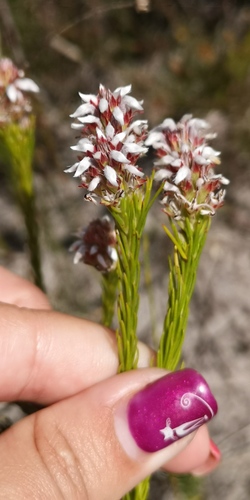
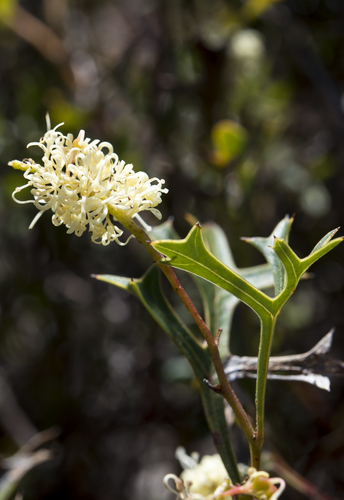
Grevillea synaphea subsp. synaphea (referenced as Grevillea synapheae in the original description) is a lignotuber-forming shrub that ranges from prostrate to erect, usually growing between 0.2 and 1.5 meters (7.9 inches to 4 feet 11.1 inches) tall. Its branches are glabrous or covered in sparse woolly hairs. The leaves are variable in shape, but most are wedge-shaped with 3 to 7 triangular to roughly linear lobes; the lobes are 10 to 25 millimeters (0.39 to 0.98 inches) long and 2 to 12 millimeters (0.079 to 0.472 inches) wide. Flowers are arranged in clusters with up to 6 branches, each of which is cylindrical and grows on a rachis 10 to 60 millimeters (0.39 to 2.36 inches) long. The flowers themselves are white to creamy yellow, with a pistil 4 to 5 millimeters (0.16 to 0.20 inches) long. Flowering takes place from July to October, and the fruit produced is a wrinkled, elliptic to oval follicle 8 to 13 millimeters (0.31 to 0.51 inches) long. This subspecies of grevillea is closely related to Grevillea trifida, Grevillea muelleri, and Grevillea prominens. All five subspecies of Grevillea synaphaea occur in the south-west of Western Australia. Grevillea synaphea subsp. synaphea is moderately common on and east of the Darling Range, with a range extending from Perth suburbs south to Narrogin and Williams, and north to Gingin and Toodyay. It occurs across the Avon Wheatbelt, Geraldton Sandplains, Jarrah Forest, and Swan Coastal Plain bioregions. Common under the horticultural name catkin grevillea, this plant is sold commercially and recommended for use as a low ornamental shrub. It is suitable for planting on wide road verges, median strips, open locations, reserves, and parks. When planted in large numbers, it forms a low hedge, barrier, or groundcover. It tolerates drought, moderate frost, and soils with high lime content. It requires well-drained soil and grows best in part shade to full sun. The plant attracts birds, which use it for food and habitat. Contact with this plant can cause skin irritations.