About Hakea ruscifolia Labill.
Nomenclature and Growth Form
Hakea ruscifolia Labill., commonly called candle hakea, is a dense woody shrub that forms a lignotuber.
Size Dimensions
It typically grows 0.5 to 3 metres (2 to 10 feet) high and 1.5 to 2 metres (5 to 7 feet) wide.
Branch and Flower Arrangement
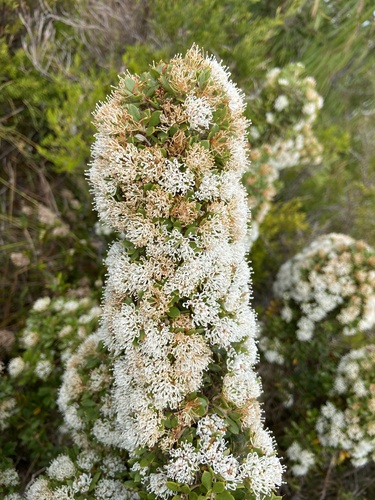
Its branches usually grow in a columnar habit, with flowers that envelop the stems.
Flowering Period and Flower Characteristics
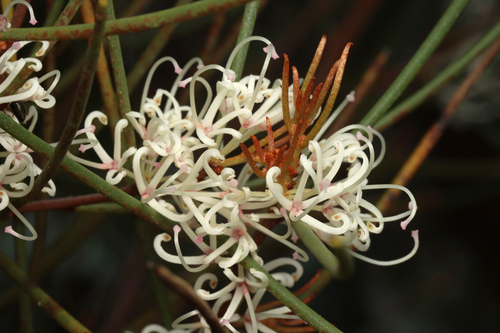
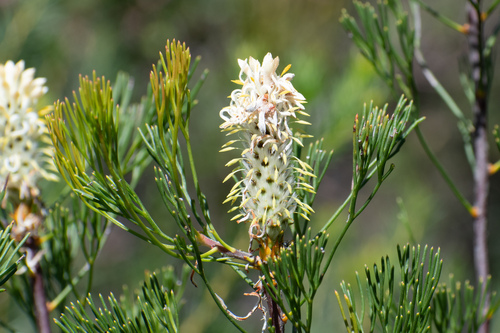
It blooms from December to June, producing sweetly scented white flowers in leaf axils on short lateral outer branchlets.
Leaf Shape and Texture
Its leaves are thickly crowded, small, and range in shape from elliptic to obovate, ending in a fine sharp point.
Leaf Size
Most leaves measure 2 to 4 cm (0.8 to 2 in) long and less than 1 to 2 cm (0.4 to 0.8 in) wide.
Fruit Characteristics
The species produces relatively small, smooth, compressed, ovoid-shaped fruit that is 1 to 2 cm (0.4 to 0.8 in) long, less than 1 cm (0.4 in) wide, and ends in a small beak.
Distribution Range
Candle hakea is a widespread species found in coastal and inland areas, ranging from Eneabba to Augusta, extending east to Esperance.
Habitat and Substrate
It grows in heath and scrubland on sand, gravelly clay, and laterite.
Ornamental Use
It is a hardy ornamental species that tolerates moderate frost and works well as an understory shrub.