About Protea cordata Thunb.
Common Names and Native Range
Protea cordata, commonly called heart-leaf sugarbush, or hartblaarsuikerbos in Afrikaans, is a plant species native to Southern Africa. It grows in or on woody soils.
Trunk Characteristics
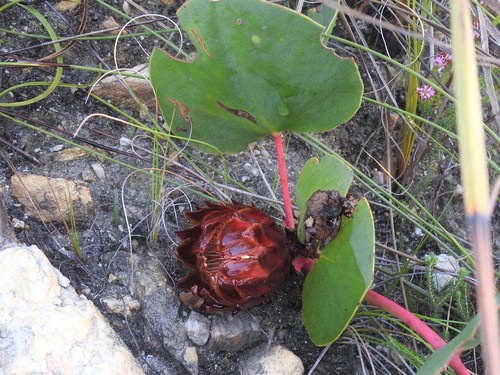
Its unbranched, smooth red trunk can reach 500 mm in length.
Basal Leaf Morphology
Brown, lance-shaped, scaly leaves grow at the base of the stem.
Upper Stem Leaf Morphology
Further up the stem tip, some stalkless, heart-shaped leaves arrange in a zigzag pattern, while other leaves reduce in size gradually.
Reproduction and Pollination
This species is self-incompatible, and small mammals and insects have been found to contribute to its reproduction and seed distribution.
Inflorescence Structure
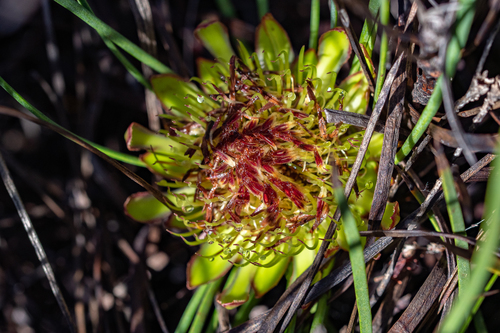
Its inflorescence is shaped like a cup, formed by dry, brown papery bracts. The cup surrounds a cream-colored flower with a red tip, and an orange-brown flower sits at the base of this flower.
Trunk Growth Cycle
A new trunk grows from the woody subsoil; the old trunk dies after one to two years and is eventually blown away.
Seed and Fruit Basics
Each inverted fruit holds a single seed.
Infructescence and Fruit Traits
The infructescence is covered by a thick layer of green, brown or orange-brown bracts, and the individual fruits are covered with a thin layer of white upturned hairs, and fruits can be yellow, green or yellowish-orange in color.